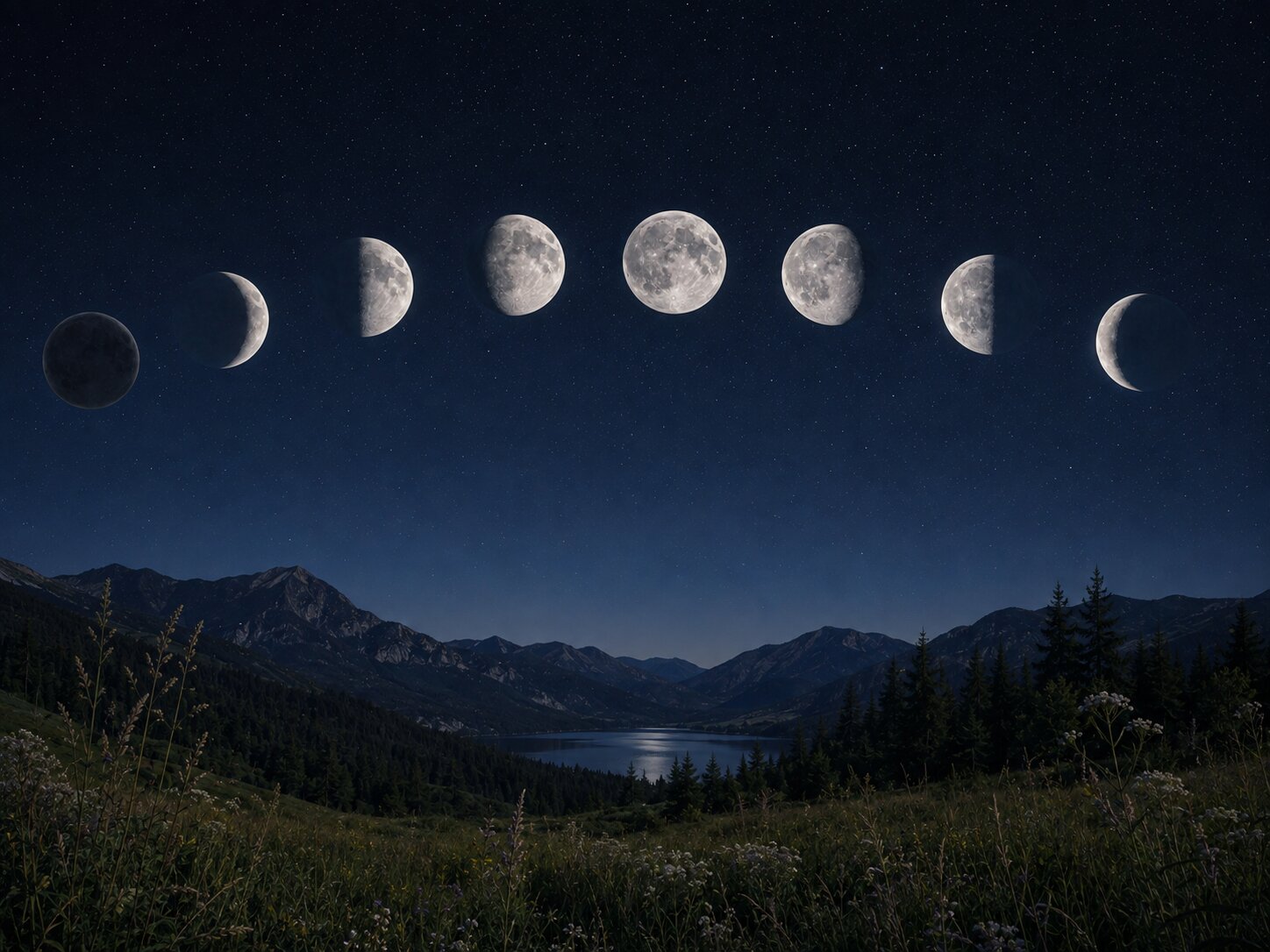
The Moon changes a little every night, but its cycle follows a dependable rhythm. This guide brings the eight moon phases in order into one place, combining the astronomy of the lunar cycle with the meanings, reflective practices, and original music that make each phase worth slowing down to notice.
You can use this page as a map. Start with the phase you see tonight, follow the cycle from beginning to end, or explore the phase whose symbolism fits the season of life you are in.
The 8 Moon Phases in Order
- New Moon — beginnings, reflection, and intention.
- Waxing Crescent — first movement, hope, and building momentum.
- First Quarter — decision, challenge, and action.
- Waxing Gibbous — refinement, patience, and preparation.
- Full Moon — illumination, gratitude, and completion.
- Waning Gibbous — gratitude, sharing, and integration.
- Last Quarter — release, adjustment, and making room.
- Waning Crescent — rest, stillness, and closure.
What Causes the Moon Phases?
The Moon does not create its own light. Half of it is always illuminated by the Sun, and as the Moon orbits Earth we see different portions of that sunlit half. Those changing viewing angles create the phases. One complete cycle from new moon to new moon takes about 29.5 days.
Moon Phase Meanings
Astronomy explains what the phases are; human cultures have also used the lunar cycle as a framework for calendars, stories, festivals, agriculture, spirituality, and reflection. Modern moon-phase meanings are best understood as symbolic practices rather than scientific claims that a phase controls human behavior.
A Simple Way to Follow the Lunar Cycle
Choose one place where you can see the sky and return to it several evenings each week. Notice the Moon’s shape, where it appears, how the light changes, and what is happening in the landscape around you. Keep a few lines of notes. Within one cycle, the phases stop feeling like eight definitions and begin to feel like a moving rhythm.
The Rhythm Rielly Moon Series
Each guide in this series pairs the lunar phase with an original Rhythm Rielly song and video. The written guides answer the practical questions people bring to the Moon—what the phase is, what it traditionally represents, and ways to observe it—while the music approaches the same phase emotionally.
Begin with the New Moon guide and move through the cycle, or choose any phase above to explore its full article and video.
Leave a Reply