The Secret Life of Tarot · Part VI
This article contains affiliate links. As an Amazon Associate, I earn from qualifying purchases.
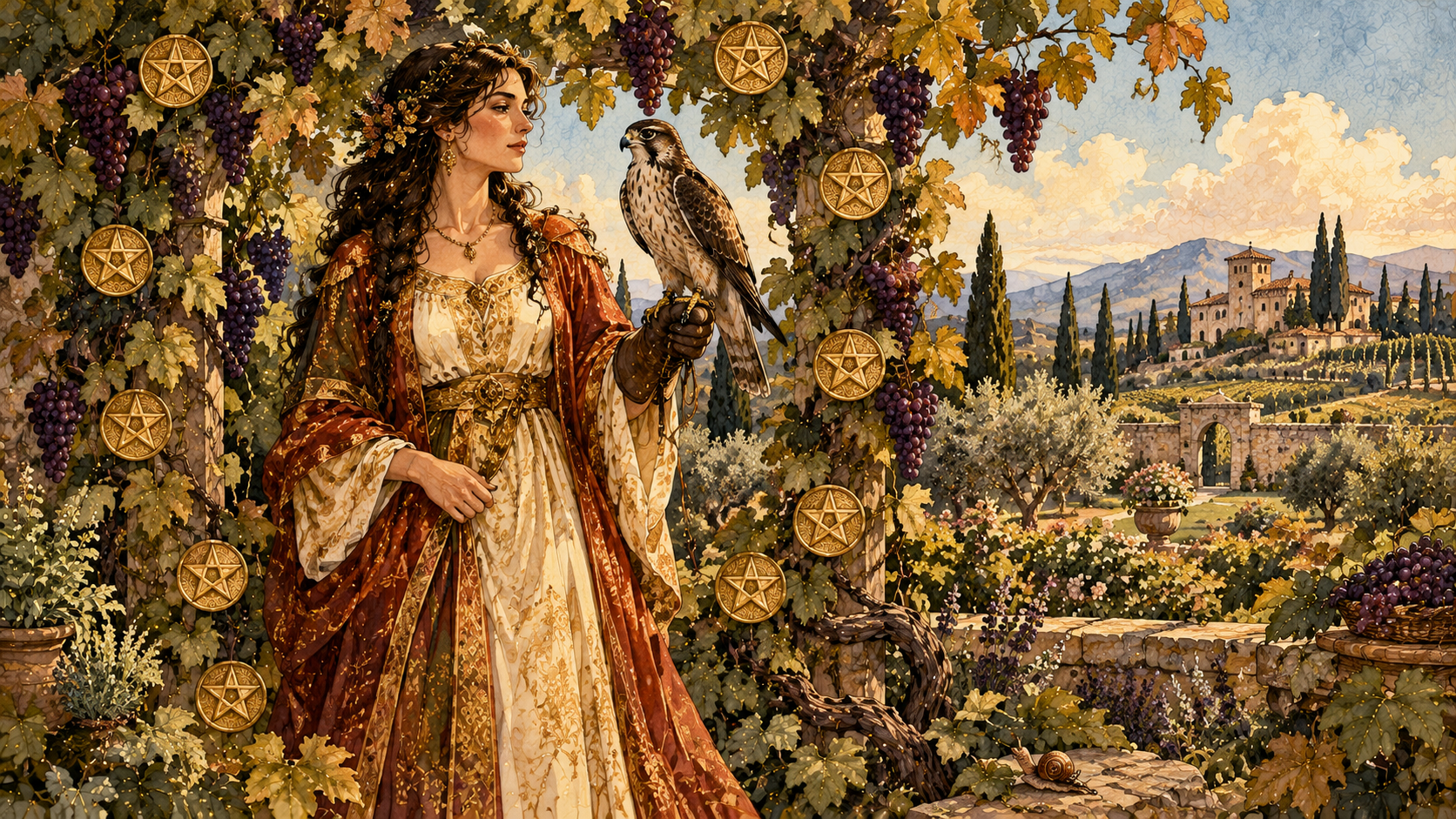
A woman stands alone beneath heavy grapevines. Nine pentacles gleam among the leaves; a large house rises beyond.
On her gloved hand sits a bird of prey.
It looks like an elegant finishing touch, but the bird raises a question. Why is a creature made for flight resting quietly in a garden that seems to offer every possible comfort?
Look lower, and another animal appears: a tiny snail crossing the ground near her feet.
One flies swiftly; the other moves slowly. Together they make the card more than a picture of wealth.

Is the Bird in the Nine of Pentacles Really a Falcon?
In Pamela Colman Smith’s Rider–Waite–Smith illustration, a richly dressed woman holds a bird upon her raised wrist. The bird is commonly identified as a hooded falcon, though the stylized drawing does not establish its species with certainty.
Arthur Edward Waite’s original description calls it simply a bird. He describes the surrounding grapevines, a large estate, and the possibility that the woman owns the property. He does not provide a separate explanation of the bird’s symbolism.
So interpretations about mastered instincts, freedom, patience, or control are later readings rather than established statements of the artist’s intent.
Still, the glove and calm bird suggest a relationship.
That invites a closer look at falconry.
Falconry: A Partnership With Something Wild
Falconry is the traditional practice of training birds of prey to fly and hunt. It has a long history across different cultures and is recognized by UNESCO as living cultural heritage.
A falcon is a hunter with sharp talons. Its safe care requires training and attention to welfare.
The relationship is more complex than simply possessing an impressive animal. A falconer must learn to work with the bird’s natural abilities rather than treating it as a decorative possession.
A trained bird still has its own needs and instincts. This is not simply domination.
Now return to the Nine of Pentacles.
The calm bird implies skills practiced beyond the picture.
The luxury we see may rest on work we do not see.
Why Is the Falcon Wearing a Hood?
The bird in the traditional card appears hooded, a detail often missed in modern illustrations.
In falconry, appropriately fitted hoods temporarily cover a raptor’s eyes. They are used in certain handling situations to reduce distracting visual stimuli. Proper use requires training and attention to the bird’s comfort and welfare.
The hood does not prove that anyone has conquered the bird’s spirit.
But the contrast is compelling: a creature capable of flight waits quietly on a gloved wrist.
For a reflective tarot reading, the image might raise questions about timing. When is it wise to act, and when is it wise to prepare? What does it take to keep a powerful ability ready without using it constantly?
The falcon’s stillness is not the same thing as having no potential.
The Vineyard: Abundance That Needs Tending
The grapes growing around the woman are not wild treasure scattered on the ground. They belong to an established vineyard.
Grapevines are woody perennial plants. To keep them healthy and productive, growers train their growth on supports and prune them regularly. University of Minnesota Extension explains that fruit grows on new shoots arising from buds formed the previous season.
The result is a strange kind of abundance: to encourage a productive future, a grower must deliberately remove much of the current growth.
A ripe cluster can reflect seasons of observation, restraint, and care.
The woman stands among the fruit without a basket or pruning shears. The card does not tell us who performed the vineyard’s labor. Waite even says only that the estate might belong to her.
Wealth may reflect work, inheritance, fortune, or other people’s labor.
Still, the cultivated landscape is an evocative symbol of sustained attention. Not every reward arrives quickly, and not every form of plenty sustains itself.
The Tiny Snail at Her Feet
If the falcon catches your eye, look down.
A small snail appears along the lower edge of the original picture. It is so easy to miss that many reproductions and interpretations barely mention it.
Unlike the bird, the snail cannot soar beyond the garden walls. It moves on a muscular foot and carries a coiled shell, withdrawing into it when threatened or conditions become difficult.
Symbolically, the snail contrasts with the bird.
The falcon suggests speed, reach, and trained readiness. The snail suggests patience, protection, and a slower relationship with the world.
Neither is superior.
One travels far; the other advances carefully.
The woman stands between them, surrounded by a garden whose abundance also took time to develop.
Maybe the card is not asking us to choose between ambition and contentment. Perhaps it invites us to make room for both.
Why Are There Nine Pentacles Among the Grapes?
Nine golden discs are arranged throughout the vines, linking the scene to the suit of Pentacles and its concern with material resources, work, security, and the physical world.
They are integrated into the garden, not stacked in a chest.
That suggests a question beyond “How much money do I have?”
What resources make a life feel rich: space, food, time, skill, comfort, autonomy, or the ability to enjoy an afternoon without rushing toward another obligation?
The card offers no single answer.
Does Being Alone Mean She Is Lonely?
No one else stands beside the woman, but solitude does not automatically mean loneliness.
She appears at ease, surrounded by an estate extending beyond the frame.
Modern readings often associate the Nine of Pentacles with self-sufficiency and independence. That’s a reasonable symbolic interpretation, but it should not turn into a rule that success means never needing help.
Even the vineyard depends on living soil, weather, pruning, and care. The falcon depends on a demanding relationship with its handler.
Independence can coexist with connection.
The woman may simply be enjoying the rare pleasure of standing still in a life she has helped shape.
Upright and Reversed in a Tarot Reading
Upright, the Nine of Pentacles commonly invites reflection on security, competence, earned comfort, and the ability to enjoy what has been built. The falcon can represent a capacity held in readiness; the grapes can evoke long-term cultivation.
Reversed, readers may consider overwork, fragile security, dependence, or difficulty enjoying success. Is the garden truly flourishing, or does keeping everything perfect demand more than it gives?
These are reflections, not financial predictions.
A Small Vineyard Reflection
Study the original card, beginning with the bird and following your gaze through the grapevines to the snail.
In a journal, consider:
- What have I cultivated patiently that I rarely pause to appreciate?
- Which abilities do I need to practice—and which can I let rest?
- What would genuine independence look like if it still allowed support and connection?
For close study of Smith’s symbolism, explore the Rider–Waite Tarot Deck on Amazon. To keep track of recurring details and changing interpretations, explore a Tarot Journal on Amazon.
Frequently Asked Questions
What kind of bird is in the Nine of Pentacles?
It is commonly interpreted as a hooded falcon or other trained bird of prey. Waite called it a bird without identifying a species.
What does the falcon symbolize?
Readers often connect it with discipline, independence, skill, and potential held in reserve. These are interpretations rather than a fixed meaning supplied by Waite.
What does the snail represent?
The snail is commonly interpreted as patience and slow progress. Its small presence complements the fast, powerful bird and the mature vineyard.
The Freedom to Stand Still
The Nine of Pentacles contains a bird made for flight, a snail made for careful movement, and a woman standing amid a harvest.
Nothing in the scene is racing.
The vineyard has ripened. The falcon rests. The snail continues on its quiet way.
Perhaps the most remarkable luxury here is not the house, the gold, or the beautiful robe.
It is the space to recognize what has grown—and to decide what deserves attention next.
Freedom is not always leaving. Sometimes it is having the choice to remain.
Continue Exploring
Read about The Empress’s cultivated garden and the quiet independence of the Queen of Wands’ black cat.
Sources and Further Reading
- Arthur Edward Waite, The Pictorial Key to the Tarot: Nine of Pentacles.
- Pamela Colman Smith, Nine of Pentacles, original 1909 card.
- UNESCO, Falconry, a Living Human Heritage.
- University of Minnesota Extension, Growing Grapes in the Home Garden.

Leave a Reply