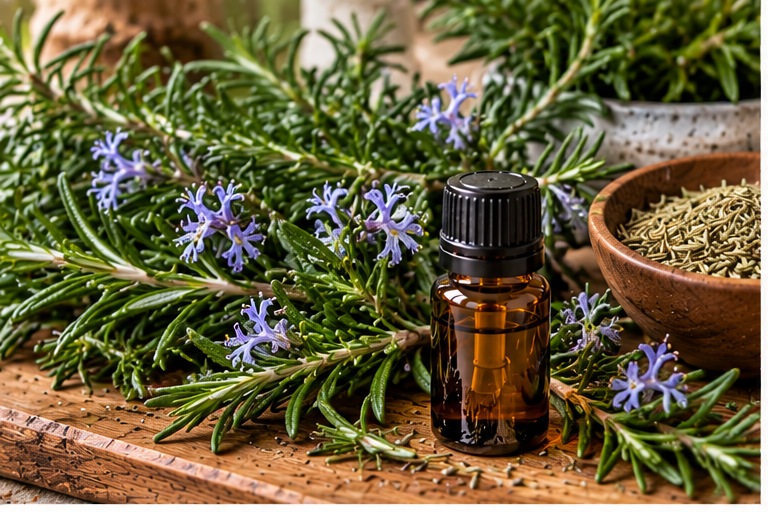
There are herbs you have to lean toward to smell.
Rosemary isn’t one of them.
Brush your hand across a sun-warmed rosemary bush and the fragrance follows you—green, resinous, woody and almost startlingly fresh.
That intensity is concentrated even further in rosemary essential oil.
Today, rosemary oil turns up everywhere from diffusers to scalp treatments. Somewhere between ancient herb gardens and modern beauty routines, however, we’ve managed to blur together several very different products under the words “rosemary oil.”
So let’s untangle them. And then let’s follow rosemary all the way back to the plant.

What Is Rosemary Essential Oil?
Rosemary essential oil is the volatile aromatic oil obtained from the rosemary plant, usually through steam distillation.
You may recognize its botanical name as Rosmarinus officinalis.
Botanical classification has changed, however, and rosemary is now generally accepted as Salvia rosmarinus, placing our familiar kitchen rosemary firmly within the Salvia genus alongside the sages. You’ll still encounter Rosmarinus officinalis constantly on product labels, books and older research, so knowing both names is useful. Kew’s Plants of the World Online provides the current botanical record.
Rosemary belongs to the mint family, Lamiaceae—the same wonderfully aromatic family that gives us plants such as mint, basil, thyme, lavender and sage.
From Rosemary Bush to Essential Oil
A rosemary shrub doesn’t look especially delicate. Its narrow evergreen leaves cling to woody stems, tolerating sun, heat and dry conditions that would leave fussier garden plants looking personally offended.
But inside those leaves are volatile aromatic compounds.
During steam distillation, steam passes through rosemary plant material and carries those volatile compounds with it. The vapor is cooled and condensed, allowing the essential oil to separate from the resulting aromatic water.
The bottle that emerges is extraordinarily concentrated compared with the rosemary sprig growing outside. That’s why cooking with rosemary and using rosemary essential oil are very different things.

What Does Rosemary Essential Oil Smell Like?
Rosemary essential oil is intensely herbal, green, woody, resinous, penetrating, slightly camphoraceous and fresh without being sweet.
If lavender feels soft and peppermint feels icy, rosemary feels clear and green.
It smells like sun hitting an herb garden. That character makes rosemary particularly good at anchoring blends that might otherwise become too floral or sweet.
Ways to Use Rosemary Essential Oil
1. Diffuse Rosemary Essential Oil
Rosemary’s strong herbal aroma makes it an interesting diffuser oil on its own, but it really shines in blends. Try combining it with citrus for brightness, lavender for softness or cedarwood for a deeper woody character.
Follow your diffuser manufacturer’s directions and start conservatively. Essential oils don’t need to overwhelm a room to be noticeable.
2. Create a Diluted Aromatic Roller
For topical aromatic use, rosemary essential oil should be diluted appropriately in a carrier oil rather than applied neat. Jojoba and fractionated coconut oil are convenient carrier choices, and small glass roller bottles make blends easy to store and use.
3. Use Rosemary in Bath and Body Products
Rosemary’s herbal scent works beautifully in soaps, scrubs and other properly formulated bath products. But essential oil and water don’t simply mix because we want them to. Adding concentrated drops directly to bathwater can leave undiluted oil floating on the surface where it can contact the skin. For homemade body products, formulation matters.
4. Bring Rosemary Into Home Fragrance
Rosemary combines beautifully with lemon, orange and evergreen aromas. It can make a room smell less like “perfume” and more like someone opened the windows beside an herb garden.
During winter, rosemary also pairs beautifully with fir, cedarwood and citrus for a botanical alternative to sweeter holiday fragrances.
5. Grow the Plant
This may be my favorite way to experience rosemary. Run your hand through a mature rosemary shrub and the essential oil announces itself before you’ve distilled a single thing.
Fresh rosemary gives you an aromatic garden plant, culinary herb, pollinator-friendly flowers and one of the simplest sensory lessons in plant chemistry imaginable.
Rosemary Essential Oil Blends
Rosemary has enough character to stand on its own, but blending reveals different sides of it.
Rosemary + Lavender
Herbal and floral. Lavender softens rosemary’s sharper edges while rosemary gives lavender more structure.
Rosemary + Peppermint
This is an unapologetically fresh combination. Peppermint brings the cold brightness; rosemary contributes the woody green backbone.
Rosemary + Lemon
Clean, sunny and herbaceous. Lemon lifts rosemary beautifully without hiding its character.
Rosemary + Cedarwood
Instead of making rosemary brighter, cedarwood grounds it. The result feels woody, quiet and earthy.
Rosemary + Sweet Orange
Sweet orange takes rosemary somewhere warmer. The combination can feel almost like walking through a Mediterranean garden with citrus trees nearby.

Rosemary Oil for Hair: What Are People Actually Using?
Search for rosemary oil online and you’ll quickly find people rubbing something called “rosemary oil” into their scalps.
But there’s an important question hiding inside that phrase: What kind of rosemary oil?
A bottle of pure rosemary essential oil is a highly concentrated aromatic product. A commercial rosemary hair oil, meanwhile, may already contain rosemary essential oil diluted into castor oil, jojoba, coconut oil or another carrier.
Those products aren’t interchangeable.
If a product is sold specifically as a ready-to-use hair or scalp oil, follow its label. If you’re holding a bottle of concentrated rosemary essential oil, don’t assume that viral videos showing someone pouring “rosemary oil” directly onto their scalp are demonstrating the same product.
Does Rosemary Oil Actually Help Hair Grow?
This is where rosemary becomes genuinely interesting—and where the internet tends to sprint several miles ahead of the evidence.
A small randomized comparative trial published in 2015 followed 100 men with androgenetic alopecia. Participants used either rosemary oil or 2% minoxidil.
At three months, neither group showed a significant change in hair count. At six months, hair counts had increased significantly from baseline in both groups, and researchers reported no significant difference in hair count between the groups at that point.
That’s promising enough to justify further research. It does not prove that rosemary essential oil is a universal substitute for minoxidil, that it treats every cause of hair loss, or that putting undiluted rosemary essential oil on your scalp will make your hair grow.
Hair loss has many possible causes. One small study involving one type of hair loss cannot answer all of those questions. Still, it gives rosemary something more interesting than an internet rumor: an actual human clinical study worth following.
Rosemary Essential Oil vs. Rosemary Hair Oil
Rosemary essential oil is concentrated.
Rosemary-infused oil is typically made by infusing rosemary plant material into a carrier oil.
Rosemary hair oil is a finished cosmetic product whose ingredients and concentration depend on the manufacturer.
All three might be called “rosemary oil” in casual conversation. They are not necessarily the same thing. Always read the ingredient list.
Rosemary, Memory and Remembrance
Long before rosemary became trendy on social media, it carried an association with memory.
Rosemary has appeared historically in traditions surrounding remembrance, weddings, funerals and fidelity. That symbolism fits the plant strangely well. Its fragrance clings. Touch the leaves and the scent remains on your hands long after you’ve walked away.
The association between rosemary and memory has also inspired modern research, but traditional symbolism and clinical evidence aren’t the same thing. We don’t need to turn every beautiful old plant tradition into a medical claim for it to remain meaningful.
Sometimes symbolism gets to be symbolism.
The Rosemary Plant Has a Story of Its Own
Rosemary is native to the Mediterranean region and grows as an evergreen shrub. Its needle-like leaves, woody growth and tolerance for relatively dry conditions make perfect sense when you understand where the plant came from.
It belongs to the same botanical family as many of our most aromatic culinary and medicinal herbs. When it flowers, its small blossoms can become valuable feeding places for visiting pollinators.
Can You Grow Rosemary at Home?
Absolutely—if you can give it the conditions it likes.
- plenty of sunlight
- excellent drainage
- air circulation
- soil that doesn’t remain soggy
- restraint with watering once established
Rosemary evolved around Mediterranean conditions, and constantly wet roots can be far more troublesome than a little dryness. It also grows beautifully in containers.
Given time, what began as a tiny nursery herb can become a substantial woody shrub. And once you have one growing nearby, buying rosemary purely for its fragrance begins to feel almost silly.
Just brush the leaves. The plant will do the rest.
Diffusing rosemary essential oil should be brief and in a well-ventilated room, following the diffuser’s instructions. Avoid use around infants and young children and seek veterinary guidance before diffusing around pets, particularly birds or animals with respiratory problems. Never apply undiluted oil to the scalp or use ordinary aromatherapy essential oil as an oral product.
Rosemary Essential Oil Safety
The fact that rosemary lives in the spice cabinet doesn’t make its concentrated essential oil equivalent to the culinary herb.
Essential oils can irritate skin and may cause harmful effects when misused or swallowed. For topical aromatic use, concentrated essential oils should generally be appropriately diluted in a suitable carrier rather than casually applied neat. Stop using a product if it causes a rash or other skin reaction.
Essential oils should also be kept securely away from children and pets. If an essential oil is swallowed accidentally or causes concerning symptoms, contact an appropriate medical professional or poison center rather than attempting an internet remedy. Poison Control’s essential-oil safety guidance is a useful reference for exposure and poisoning concerns.
How to Store Rosemary Essential Oil
Store rosemary essential oil tightly closed, away from excessive heat and direct sunlight, clearly labeled, and somewhere children cannot reach it.
Dark glass bottles are commonly used for essential oils, and a storage case can make a growing collection considerably easier to organize.
Because yes: Lavender becomes peppermint. Peppermint becomes rosemary. And suddenly you own twelve tiny amber bottles.
What Should You Look for When Buying Rosemary Essential Oil?
Start by reading beyond the words ROSEMARY OIL on the front.
Look for a botanical identification such as Salvia rosmarinus or the still-common synonym Rosmarinus officinalis. A transparent seller may also provide information about plant part, extraction method, country or region of origin, batch or lot number, chemical testing and storage instructions.
If you want a diffuser oil, you’re probably looking for rosemary essential oil. If you want a convenient scalp product, you may prefer a properly formulated rosemary hair oil that’s already diluted and labeled for that purpose.
Useful Supplies for Rosemary Aromatherapy and Hair Care

This section contains paid affiliate links. As an Amazon Associate I earn from qualifying purchases, at no additional cost to you.
Rosemary Essential Oil
Look for clear botanical labeling and use this concentrated product only as directed, diluted when appropriate for topical fragrance use. Explore rosemary essential oil.
Ready-to-Use Rosemary Scalp Oil
A prepared scalp product can be more convenient than making a mixture yourself. Check its ingredient list, application instructions and warnings before use. Explore rosemary scalp oil.
Ultrasonic Essential-Oil Diffuser
Use conservatively for short aromatic sessions, following the manufacturer’s instructions and keeping children and pets in mind. Explore the ultrasonic diffuser.
Jojoba Carrier Oil
A carrier oil is useful when preparing properly diluted adult topical blends from concentrated essential oil. Explore jojoba carrier oil.
Rosemary Beyond the Bottle
Rosemary is exactly the kind of plant that makes this Essential Oils Library worth building.
Start with the bottle and you end up somewhere much larger.
Botany. Gardening. History. Folklore. Chemistry. Beauty rituals. Scientific research.
And eventually, inevitably, standing beside a rosemary bush with your fingers buried in its branches because smelling the actual plant is still better than reading about it.
Lavender Essential Oil softened the room.
Peppermint Essential Oil threw open the windows.
Rosemary walks in carrying the whole garden.


Leave a Reply