The Secret Life of Tarot · Part IV
This article contains affiliate links. As an Amazon Associate, I earn from qualifying purchases.
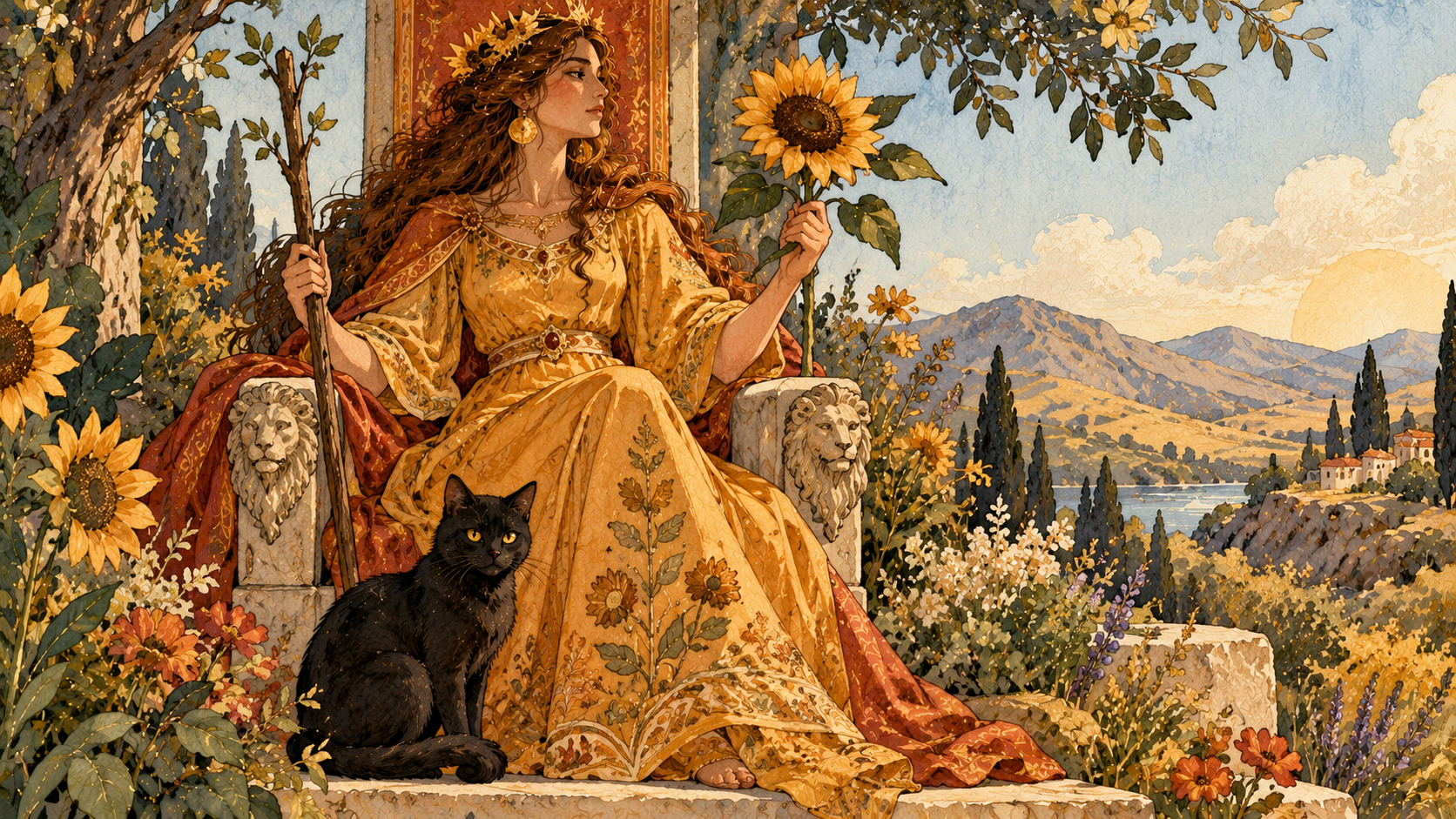
The Queen of Wands sits beneath a brilliant sunflower, dressed in gold, with lions carved into her throne. She looks entirely at home in the sunlight.
Then you notice the little black cat at her feet.
The animal is small, almost tucked into the border of Pamela Colman Smith’s illustration. Yet it looks directly outward, toward the person holding the card. While the Queen gazes to one side, her companion seems to notice us.
Why would a card filled with golden flowers, fire, and confidence include an animal so often associated with shadows and witchcraft?
Perhaps the question is not why darkness has entered this sunny scene. Perhaps it is why we assume the two cannot belong together.

What Does the Black Cat Mean in the Queen of Wands?
The Queen of Wands belongs to the Minor Arcana. In the Rider–Waite–Smith deck, she holds a leafy wand in one hand and a large sunflower in the other. Lions decorate her throne, and a black cat sits quietly in front.
Arthur Edward Waite described the Queen as magnetic, friendly, loving, and honorable. He associated the Wands with life and animation because the staffs throughout the suit remain in leaf.
But in his written description, Waite did not assign a specific meaning to the cat.
That distinction matters. A black cat as a familiar, a guardian, a sign of intuition, or an emblem of independence can make a compelling modern interpretation. None should be presented as an explanation we know Smith intended.
What we can study is where she placed the animal—and what that choice makes us notice.
The Cat Faces the Viewer
Look at the figures again.
The Queen’s attention turns away from us. The cat’s face points outward. Small as it is, the creature occupies a strangely important position: the threshold between the Queen’s seat and the world beyond the picture.
It is tempting to imagine the cat as a companion that sees what its queen does not. That is an interpretation, not an identified secret in the original design.
Still, the composition gives the cat a presence of its own. It is not being carried, displayed, or restrained. It has settled where it chooses.
The Queen holds the wand and sunflower. The cat holds nothing.
One figure expresses authority; the other quietly possesses itself.
The scene suggests the possibility of being welcoming without surrendering one’s independence.
Why a Black Cat—and Not a Bad Omen?
Black cats have lived under contradictory human stories for centuries.
In some European traditions, dark cats became entangled with fears of witchcraft, dangerous magic, and misfortune. Art and popular culture repeated the association until a black cat crossing someone’s path became a familiar superstition.
Yet other traditions treated them as lucky. The Smithsonian’s Archives of American Art notes that black cats aboard ships could signify good fortune; traditions in places including the United Kingdom and Japan also gave them favorable meanings.
The animal did not change when it crossed a border. The stories people told about it did.
So which meaning belongs on the Queen of Wands?
The artwork cannot settle that question for us, and neither can superstition. But the cat sits comfortably in the court of a powerful woman, with no visible sign that its presence is unwelcome.
Instead of automatically treating the cat as danger, we might ask why a confident queen would need to fear it at all.
What Real Cats Teach Us About the Unknown
A cat does not require supernatural powers to seem mysterious.
Domestic cats are often especially active around dawn and dusk, a pattern veterinarians call crepuscular. Their senses help them investigate movements and sounds people may overlook.
Even an ordinary cat watching a doorway can seem to know something we have missed.
And the coat itself is not mysterious in a biological sense. Its rich black color is connected to inherited pigmentation. Researchers have identified genetic variants involved in black coloration in domestic cats.
A black coat is not an omen. It is an expression of feline biology.
That difference opens a beautiful possibility for the card. We can enjoy the cat’s mystery without demanding that it predict anything.
It may remind us to observe more carefully, respect the unfamiliar, and resist filling every silence with an explanation.
The Sunflower and the Cat: Two Ways of Being Seen
The Queen’s sunflower is enormous and unmistakable. Its bright petals catch the eye almost immediately.
The black cat is the opposite: compact, dark, and easy to miss until we deliberately look downward.
Together, they make a striking visual pair.
The sunflower offers a public image of warmth, generosity, and creative vitality. The cat suggests an equally valuable private quality: the freedom to keep one’s own counsel.
This is our reading of the composition, not a code documented by Waite.
The Queen doesn’t need to choose between them. She can welcome the world without explaining every part of herself to it.
Perhaps real confidence is not constant performance. Perhaps it includes knowing when to shine and when to sit quietly in one’s own company.
Why Are There Lions on Her Throne?
Two carved lions form the arms of the Queen’s seat, with additional lion imagery behind her.
Lions traditionally evoke strength, royalty, courage, and command. On this card, they reinforce the Queen’s authority.
But notice the difference between those carved lions and the living cat at her feet.
The lions belong to the throne. They are part of the machinery of royalty—fixed, formal, impressive.
The little cat is alive. It can stand, leave, or turn away.
One kind of feline power is displayed in stone. Another rests quietly on the ground.
In that contrast, the cat becomes something more than a miniature lion. It embodies a kind of independence no throne can manufacture.
Queen of Wands Upright and Reversed
Upright, the Queen of Wands is commonly associated with confidence, generosity, enthusiasm, and self-directed creativity. Her cat can invite reflection on staying independent while being open to others.
Ask: Can I share my warmth without feeling responsible for everyone’s response?
Reversed, readers sometimes explore jealousy, insecurity, control, or energy stretched too thin. The cat might prompt a different question: Have I forgotten how to make room for myself?
A tarot image offers a language for reflection, not proof that a person has hidden motives or that a future event is inevitable.
A Small Reflection with the Black Cat
Place the Queen of Wands card where you can see it clearly.
Look first at the sunflower. Then follow your gaze downward to the cat. Notice how different each figure feels, even though they belong to the same scene.
In a tarot journal, consider:
- Where am I comfortable being seen?
- What part of myself deserves privacy without shame?
- When does independence help me remain generous?
If you enjoy studying the symbols up close, explore the classic Rider–Waite Tarot Deck on Amazon.
To collect recurring details and personal interpretations, explore a Tarot Journal on Amazon.
Frequently Asked Questions
Is the black cat on the Queen of Wands a witch’s familiar?
Modern readers sometimes interpret it that way because cats feature in witchcraft folklore. Waite did not explicitly identify the animal as a familiar in his card description.
Is the black cat good luck or bad luck?
Black cats have been considered both lucky and unlucky in different cultural traditions. Their coat color itself does not cause either outcome.
What does the black cat represent in a tarot reading?
Depending on a reader’s approach, it can suggest independence, careful observation, intuition, or comfort with the unknown. These are symbolic interpretations rather than fixed predictions.
The Companion Who Needs No Crown
The Queen has her throne, her sunflower, her wand, and her lions.
The cat has none of these things.
Yet it sits at her feet without seeming diminished.
Maybe that is its quiet gift to the card: a reminder that confidence does not always need to announce itself.
The sunflower shows us how to shine. The black cat shows us how to belong to ourselves.
Continue Exploring
Discover the cultivated abundance of The Empress’s Garden and the hidden botanical imagery in the High Priestess’s pomegranate veil.
Sources and Further Reading
- Arthur Edward Waite, The Pictorial Key to the Tarot: Queen of Wands.
- Pamela Colman Smith, Queen of Wands, original card artwork.
- Smithsonian Archives of American Art, The Good, the Bad, and the Black Cat.
- VCA Animal Hospitals, Cat Behavior Problems—Nocturnal Activity.
- UC Davis Veterinary Genetics Laboratory, Feline Coat Color.

Leave a Reply