The Secret Life of Tarot · Part III
This article contains affiliate links. As an Amazon Associate, I earn from qualifying purchases.
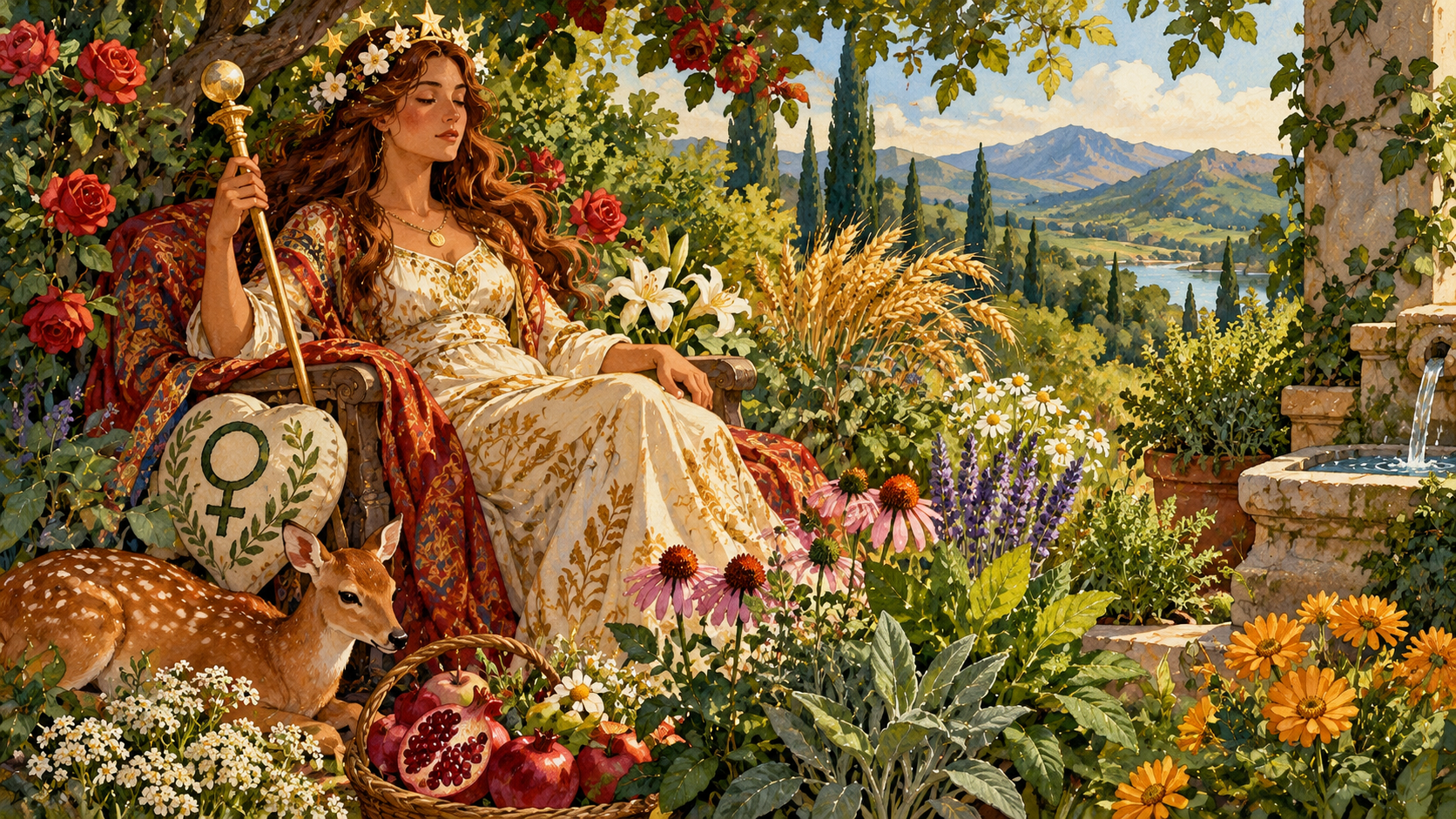
The Empress sits in a landscape so lush we almost feel we could step into it. Golden stalks rise at her feet. Water moves behind her. Trees shelter her throne, and her gown seems to bloom with small red fruits.
It’s tempting to call this a magical garden and leave it at that.
But look again.
What grows here is not merely ornamental. A crop is ripening. Water flows through the landscape. And a familiar fruit has migrated from the High Priestess’s veil onto the Empress’s clothing.
This is a garden that feeds, sustains, and changes things.
What Plants Are Actually on The Empress Tarot Card?
Pamela Colman Smith’s Rider–Waite–Smith Empress contains fewer identifiable plants than many modern retellings suggest.
The clearest is the golden grain in the foreground, conventionally identified as wheat. Behind her stands a leafy grove, but the original artwork does not establish its trees’ exact species. Her patterned robe is commonly read as decorated with pomegranates, though these are embroidered fruit, not trees growing in the field.
Arthur Edward Waite, who commissioned the deck, described ripening “corn,” flowing water, and an earthly paradise. In British English, corn can mean grain crops generally, including wheat; he was not necessarily describing American maize.
We can imagine roses, herbs, and fruit trees in her realm. But those are not all documented details of Smith’s card. The grain, meanwhile, offers a fascinating place to begin.

Wheat: The Crop That Turns Time into Food
The wheat at the Empress’s feet is tall and golden. This is not a scene of sowing; it’s a scene approaching harvest.
A wheat kernel germinates, sends roots into the soil, produces leaves and additional stems, develops a grain-bearing head, flowers, and eventually fills its kernels as they ripen.
Much of that work is invisible to anyone glancing at a field. By the time the heads turn gold, a long sequence of growth has already unfolded.
Cultivated wheat also depends on choices: seeds are planted, soil and growing conditions managed, and the grain harvested when ready. The harvest is a relationship between human attention and natural processes.
The Empress appears relaxed beside the mature stalks. But the crop tells a quieter story.
Abundance has a history.
Something was planted long before anyone could see the result.
This is a botanical interpretation, not a claim that Waite provided an agricultural lesson. Yet the difference between having abundance and cultivating it makes the card feel newly alive.
Why Is There a Waterfall Behind the Empress?
Beyond the throne, water moves through the trees and breaks into a small waterfall.
It does not sit in a decorative basin. It flows.
Every growing landscape needs water, although the picture does not depict irrigation or prove that the stream feeds the wheat directly.
Symbolically, the movement is suggestive. The garden is not a treasure chest packed with finished rewards; it is a living place where conditions change and resources circulate.
The water contrasts with the ripe grain. One is continually moving while the other has reached maturity. Growth needs both ongoing provision and the moment when something becomes ready.
Real plants have limits, too. Too little or too much water can damage a crop. The Empress need not promise endless gifts; she can remind us to notice what genuinely nourishes life.
Can We Identify the Trees in Her Garden?
Look behind the Empress and you’ll find a dark green woodland.
Some modern interpretations describe cypress trees, but Smith’s illustration is too stylized to identify every species confidently. Waite didn’t leave a botanical inventory.
The grove still matters. It encloses the scene and hints at a world continuing beyond the cultivated wheat.
Two environments share the frame: a managed field and a less orderly woodland.
Not everything growing here is meant for immediate harvest. Some living things simply belong.
The Pomegranates: A Link to the High Priestess
This may be the loveliest detail of all.
In the previous card, the High Priestess sits before a curtain embroidered with pomegranates. In the Empress, similar red fruit forms appear across her flowing gown.
The resemblance is visible, although we cannot prove Smith intended one definitive explanation.
Still, the contrast is irresistible.
The High Priestess places the fruit on a veil, separating the viewer from hidden space. The Empress wears it openly, against her body, surrounded by water and grain.
One card asks what lies beyond a curtain. The next sits among tangible things that grow.
Waite himself linked the two figures: he associated the Empress with the gateway into earthly life and the High Priestess with knowledge of what lies beyond it.
The returning fruit allows us to imagine a transition—from potential to presence, from concealed possibility to lived experience.
For the original symbolism, read Why Are There Pomegranates on the High Priestess Tarot Card?.
What Does Venus Have to Do with the Garden?
Beside the Empress rests a heart-shaped shield bearing the symbol of Venus. Above her is a crown of twelve stars.
Venus connects the card with traditional associations of beauty, desire, affection, and pleasure. The shield isn’t a plant, but it changes how we see the landscape.
The garden doesn’t exist solely to produce grain. It is also a place to enjoy warmth, texture, color, comfort, and the senses.
We can tend something for food. We can also grow something simply because its flowers delight us.
The Empress gives both kinds of care a place.
The Empress Upright and Reversed in a Reading
Upright, the Empress is commonly read as an invitation to nurture a project, relationship, or part of daily life. Her wheat asks what has been growing steadily and may be nearing harvest.
Reversed, readers may explore neglect, exhaustion, overgiving, or difficulty receiving support. Is something undernourished? Is care moving in only one direction?
Her garden is an image for reflection, not a guarantee of future events.
A Small Garden Reflection
If you grow plants, spend a few minutes with one that has changed since you planted it. If you don’t, study a seed packet, a grain head, or the Empress card itself.
Ask yourself:
- What is still a seed in my life, and what is nearing harvest?
- What needs steady care rather than another burst of effort?
- Where can I make room for beauty without asking it to be useful?
A journal can help you revisit these questions as things grow. Explore a Tarot Journal on Amazon. To compare Smith’s imagery with other cards, explore the classic Rider–Waite Tarot Deck.
Frequently Asked Questions
Is that wheat or corn on the Empress tarot card?
The foreground grain is conventionally identified as wheat. Waite called it corn, a British English word that can refer to grains generally, not necessarily maize.
Are pomegranates growing in her garden?
Pomegranates are commonly identified in the pattern of her dress. The original image doesn’t clearly show pomegranate trees growing beside her.
What does the Empress’s garden symbolize?
It is commonly associated with fertility, nourishment, creativity, pleasure, and abundance. Its wheat and water also invite reflection on the care and natural processes behind growth.
The Garden Is Not Finished
The Empress’s garden isn’t a perfect, unchanging paradise.
Its grain ripens. Its water moves. Its trees continue growing beyond the border of the card.
Even the most generous harvest belongs to a season.
Perhaps that is the lesson hidden among the golden stalks:
Abundance isn’t merely what we possess. It is what we are willing to tend.
Continue Exploring
Discover the fruit on the High Priestess’s veil and the mysteries of emergence in The Moon’s crayfish.
Sources and Further Reading
- A. E. Waite, The Pictorial Key to the Tarot, III: The Empress.
- Pamela Colman Smith, The Empress, original Rider–Waite–Smith artwork.
- University of Minnesota Extension, Spring wheat growth and development.
- Oxford Learner’s Dictionaries, corn (British English usage).

Leave a Reply