The Secret Life of Tarot · Part II
This article contains affiliate links. As an Amazon Associate, I earn from qualifying purchases.
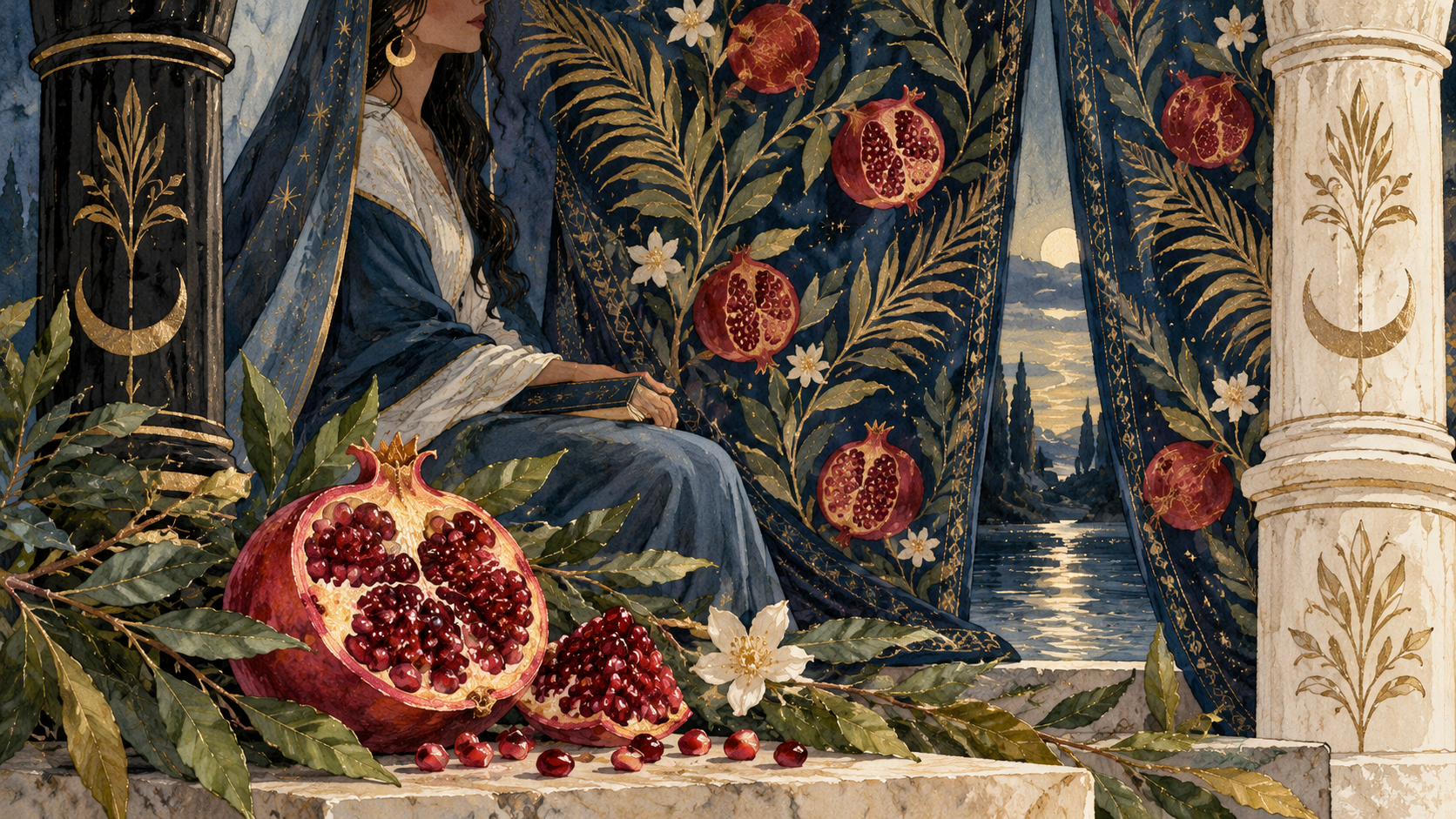
Behind the High Priestess hangs a curtain covered in ripe pomegranates. The fruit is not simply decoration.
The High Priestess sits before a threshold, holding a partly concealed scroll. Behind her, pomegranates repeat across a veil that prevents us from seeing what lies beyond.
Why this fruit, on this curtain? Follow it into ancient temples, Greek mythology, and the interior of a real pomegranate.
The answer is stranger—and more interesting—than a simple symbol of fertility.
Where Are the Pomegranates on the High Priestess Card?
In Pamela Colman Smith’s Rider–Waite–Smith illustration, the High Priestess sits between one dark and one pale pillar. The letters B and J appear near their tops. A blue drape behind her carries red pomegranates among green palm-like leaves.
The fruit does not rest in her hands. It appears on the veil behind her, separating the visible space from a hidden one.
Arthur Edward Waite described that cloth as the veil of the Temple, embroidered with palms and pomegranates. He also identified the partly covered scroll as Tora, linking her to sacred knowledge and meanings not immediately spoken aloud.
She is not sitting in an orchard but guarding a doorway.

The Surprising Connection Between Pomegranates and the Two Pillars
Here’s a detail that makes the artwork especially intriguing: in the Hebrew Bible, pomegranates and two named pillars already appear together.
The First Book of Kings describes two bronze columns at the entrance to Solomon’s Temple. They are named Jachin and Boaz, and their ornate capitals are decorated with rows of pomegranates.
Smith’s High Priestess sits between pillars labeled J and B, with pomegranates immediately behind her. Waite explicitly understood the pillars as part of his mystical Temple imagery.
The fruit belongs to a vocabulary of sacred architecture: entrances, priesthood, and the boundary between outer space and sanctuary.
The book of Exodus also describes pomegranate-shaped decorations around the hem of a high priest’s robe. Here too, the fruit belongs to ritual rather than harvest alone.
We cannot prove that Smith intended every biblical reference a viewer might recognize. Yet the correspondence between Jachin, Boaz, and pomegranates is documented, and it gives us an excellent reason to look more closely at this particular curtain.
What a Real Pomegranate Hides Inside
Pick up an unopened pomegranate. Its leathery rind offers few clues about its interior.
Cut it open and something remarkable appears: clusters of jewel-like, juice-filled arils, separated by pale membranes. Each aril surrounds an actual seed. Depending on the variety, the little chambers may glow crimson, pink, or nearly clear.
Botanically, the fruit is a structure of abundance concealed within a protective shell.
This is where the real plant becomes a useful metaphor. An unopened pomegranate contains far more than its outside reveals. To discover it, you must break the rind and separate the bitter membrane from what is edible.
That image isn’t a historical explanation Waite gave for the card; it is our interpretation of the living fruit. But it suits the High Priestess beautifully: something precious may be present without being immediately visible.
Not every mystery asks to be solved by force. Some call for patience, attention, and the ability to recognize what matters once a hidden interior is opened.
Persephone, the Pomegranate, and the Cost of Crossing a Threshold
Pomegranates also appear in a much older story about passing between worlds.
In the Homeric Hymn to Demeter, Persephone is taken into the underworld. Before her return, Hades secretly makes her taste a pomegranate seed against her will. The act binds her to spend part of each year below, away from her mother Demeter.
The original story is about abduction, loss, reunion, and an imposed condition—not a freely chosen romantic adventure. It helps explain why pomegranates can evoke the underworld and seasonal return as well as life and abundance.
Does that make the High Priestess a portrait of Persephone? No. Waite did not identify the pomegranate veil as an illustration of this myth.
But the parallel is evocative. One small seed marks a passage between realms. On the card, many seeds are hidden behind the skin of many fruits, all embroidered onto a curtain standing between the known and unknown.
The fruit has long belonged to stories about what changes when we cross a boundary.
Why Are Palms Woven Into the Veil, Too?
The pomegranates do not appear alone. Their red forms mingle with tall, branching leaves that Waite calls palms.
They bring a garden into a place of stone pillars, scrolls, and solemn ritual.
That combination is easy to miss. The High Priestess occupies a carefully ordered architectural space, yet something organic fills the curtain behind her. The living world is stitched into the sacred scene.
We can read the palms and fruits as a reminder that knowledge is not only written in books. Patterns, seasons, growth, and living things offer their own forms of understanding.
That is a poetic reading, not a documented botanical code assigned by Smith. Not every leaf has an official translation.
The Veil, the Scroll, and the Knowledge We Cannot Rush
The High Priestess holds a scroll that is partly obscured by her robe. Behind her is another concealment: the pomegranate curtain.
Two things are present, yet not wholly displayed.
This is what makes the scene more subtle than an illustration of secrecy for secrecy’s sake. She is visible. The scroll is visible. The embroidered fruit is visible. Only part of the meaning remains hidden.
The image proposes a different relationship with the unknown: study what is visible and allow understanding to develop.
Her stillness is not empty. It is deliberate.
If The Moon’s crayfish is the tiny traveler beginning to emerge from mysterious water, the High Priestess is the figure who reminds us that crossing the next threshold also requires discernment.
What Do the Pomegranates Mean in a Tarot Reading?
When the High Priestess appears upright, her veil can invite reflection on intuition, private knowledge, quiet observation, and unanswered questions. The pomegranates encourage us to consider what may be developing beneath the surface, without insisting we already know the answer.
Reversed, some readers interpret the card as a sign of ignored intuition, unclear motives, or information not yet fully understood. Others focus on the challenge of being too guarded. The surrounding cards and the question being asked always matter.
The symbolism can prompt thoughtful questions, but it cannot establish that someone is hiding a secret or predict what will happen next.
A Pomegranate Reflection
If you have a pomegranate, place it beside the High Priestess card. Observe the crown-shaped calyx, the weight of the fruit, and the intact rind. Imagine the chambers within before you open it.
Then ask yourself:
- What do I know from observation, and what am I only assuming?
- What deserves patience rather than immediate disclosure?
- What small part of a larger mystery is already visible to me?
A tarot journal can hold these reflections over time: Explore a Tarot Journal on Amazon.
For studying Smith’s original details, explore a classic Rider–Waite Tarot Deck on Amazon.
Frequently Asked Questions
Why does the High Priestess have pomegranates behind her?
Waite identified the curtain as a Temple veil decorated with pomegranates and palms. The fruit also has a documented connection to Temple ornament and priestly clothing. Modern readers associate it with hidden abundance, sacred knowledge, and thresholds.
Do the pomegranates represent Persephone?
They can suggest her myth to modern readers, but there is no clear evidence that Waite or Smith intended Persephone as the card’s central meaning.
What do the B and J pillars mean?
They refer to Boaz and Jachin, the named pillars associated with Solomon’s Temple. The biblical description of those pillars includes pomegranate decorations.
The Fruit Behind the Curtain
The High Priestess does not cut open a pomegranate for us. She sits before the veil and lets the fruit remain whole.
Perhaps that is the loveliest detail of all.
Not every hidden thing is meant to remain hidden forever. But understanding is different from exposure, and wisdom is different from having every answer at once.
The pomegranate asks us to remember that the unseen may already be full of life.
Continue Exploring
Read Why Is There a Crayfish in The Moon Tarot Card? to follow another creature crossing a boundary, or explore our Dark Moon Meaning for a different encounter with the unseen.
Sources and Further Reading
- Arthur Edward Waite, The Pictorial Key to the Tarot: The High Priestess.
- 1 Kings 7 and Exodus 28:33, biblical descriptions of pomegranate ornament.
- Homeric Hymn to Demeter, Persephone and the pomegranate seed.
- University of Georgia Cooperative Extension, Pomegranate Production.
Leave a Reply