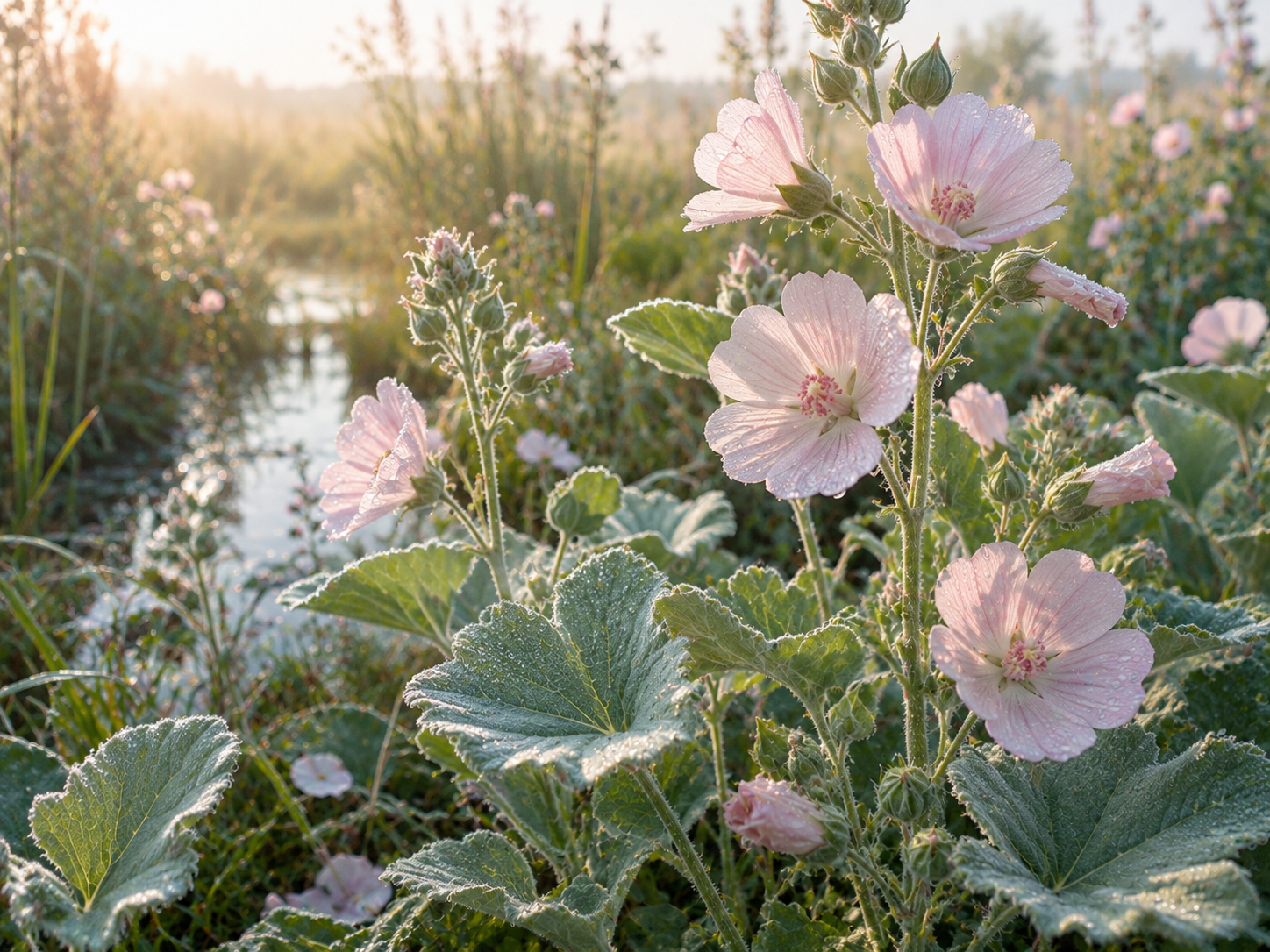
Long before marshmallows came in plastic bags, toasted over fires or disappeared beneath chocolate and graham crackers, there was a plant growing in damp ground.
Althaea officinalis is the marsh mallow: a softly textured perennial whose roots became valued for the slippery, soothing substance they release in water. Its history moves through gardens, traditional medicine and old confectionery, leaving behind one of the strangest botanical fingerprints in the modern candy aisle.
Meet Marsh Mallow
Marsh mallow belongs to the Malvaceae, or mallow family. Kew’s Plants of the World Online recognizes Althaea officinalis L. as an accepted perennial species native across a broad range from Europe into Central Siberia and western Pakistan, as well as northwestern Africa.
The plant carries the soft character that seems to follow it everywhere: downy grey-green foliage, upright stems and delicate pale pink to whitish flowers. Beneath the soil, however, lies the part that shaped much of its human history. Marsh mallow roots contain abundant mucilage—a plant material that becomes slick and gel-like when hydrated.
How to Grow Marsh Mallow
The name offers a clue. Marsh mallow is naturally associated with moist ground and is happier with reliable moisture than many Mediterranean herbs. A sunny position with rich soil that does not dry severely suits its character well, although established plants can be more adaptable than the word “marsh” suggests.
It is a perennial, so this is a plant to place with some intention. Give it enough room to develop its upright stems and substantial root system. Plants can be started from seed, and older clumps may become increasingly established over successive growing seasons.
The Root That Became a Candy
The connection between the marsh mallow plant and the marshmallow confection is not a coincidence. Preparations made from the plant’s mucilaginous root eventually entered European confectionery traditions, where the root was incorporated into soothing sweets. Over time, confectioners refined the idea into a lighter whipped candy.
Modern marshmallows generally achieve their familiar texture with ingredients such as gelatin rather than Althaea officinalis. The plant largely disappeared from the recipe, but its name remained. Every bag of marshmallows is therefore carrying around a small piece of herbal history.
Traditional Herbal Use
Marsh mallow has a long history in European herbal practice. The root’s mucilage made it especially associated with preparations intended to soothe irritated tissues.
The European Medicines Agency’s Committee on Herbal Medicinal Products recognizes marshmallow-root preparations on the basis of long-standing traditional use for irritation of the mouth or throat with an associated dry cough, and for mild stomach and intestinal discomfort. Importantly, the EMA also notes that the evidence supporting these uses is primarily traditional-use evidence rather than strong clinical-trial evidence.
That distinction matters. A plant can have a genuine and well-documented medicinal tradition without every historical use becoming a proven modern treatment.
A Very Old Herbal Reputation
European records surrounding plants called Althaea reach far back into classical herbal writing, although identifying ancient plant names with modern species is not always straightforward. The EMA’s historical assessment traces marsh mallow through later European pharmacopoeias and herbal texts, where its soothing or emollient character appears repeatedly.
Rather than treating every ancient attribution as modern medical fact, the more interesting story may be the continuity itself: generations encountered this root, mixed it with water, noticed what happened and kept remembering the plant.
Folklore, Symbolism and the Magical Tradition
Contemporary magical and folk-herbal traditions often place marsh mallow among plants associated with protection, healing, love, gentleness and soothing conflict. Such correspondences vary between traditions and are better understood as spiritual symbolism than as universal ancient doctrine.
Marsh mallow lends itself naturally to a symbolism of softening. Its most famous physical quality appears only when the root meets water: what seemed dry becomes slippery, cushioning and yielding.
Softness is sometimes mistaken for the absence of strength. Marsh mallow suggests something more interesting. A boundary does not always have to become harder to protect what is tender. Sometimes protection is the thing that coats, cushions and allows irritation to pass without taking everything with it.
Safety
Historical use does not make every preparation appropriate for every person. Marshmallow-root products vary in concentration and formulation, and medicinal use should follow the directions for the specific preparation.
Because mucilage can affect how substances move through the digestive tract, it is sensible to ask a pharmacist or clinician about timing if you take oral medicines. Pregnancy, breastfeeding, use in young children, persistent symptoms or treatment of an existing medical condition are also good reasons to seek individualized guidance rather than relying on a general herbal recipe.
Why Marsh Mallow Belongs in the Plant Library
Marsh mallow is a beautiful reminder that plants hide in ordinary language. We can say “marshmallow” without picturing a leaf, flower or root at all, even though the word once pointed directly toward a living species.
Finding the plant again changes the word. Suddenly the candy has roots. The medicine has a landscape. And softness has a history.
Sources & Further Reading
- Owen, W. (2016). Herbs: Guide to Plants, 500 Photographs, Recipes and Crafts, pp. 122–123.
- Royal Botanic Gardens, Kew. Plants of the World Online: Althaea officinalis L.
- European Medicines Agency, Committee on Herbal Medicinal Products. Althaeae radix (Marshmallow Root).
- European Medicines Agency. Assessment Report on Althaea officinalis L., radix.
This article is for botanical, historical and cultural education and is not medical advice.
Leave a Reply