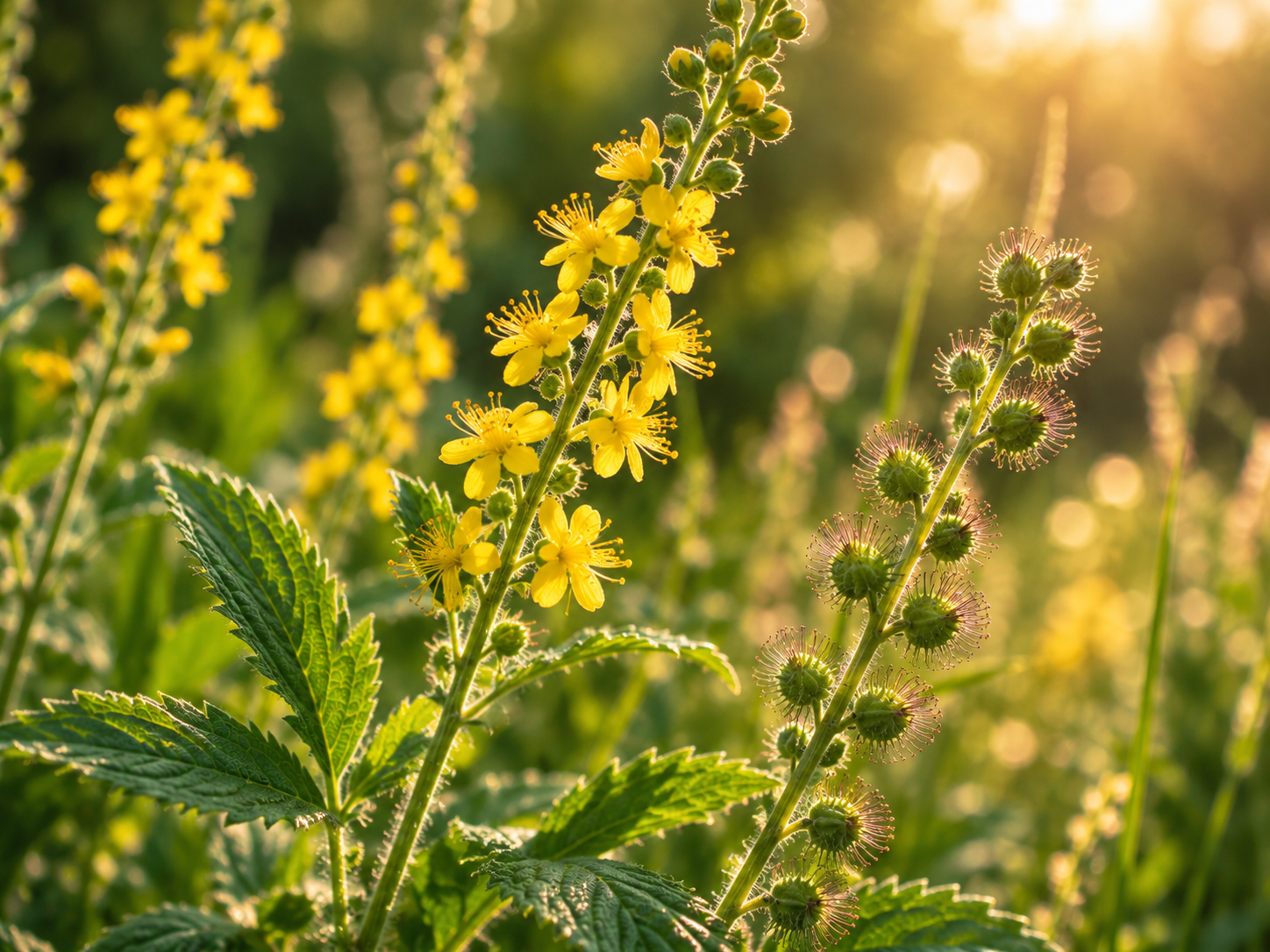
Agrimony is easy to overlook until you know what you are looking for. A slender stem rises above the surrounding grass, carrying a loose procession of small yellow flowers. Later, its hooked fruits catch on fur, fabric and passing animals—a plant that quite literally knows how to travel.
Botanists know agrimony as Agrimonia eupatoria, a member of the rose family, Rosaceae. For centuries, it has lived at the meeting place of ordinary country life and herbal tradition: growing along roadsides and field margins, appearing in old remedies, and eventually gathering a second life in folklore and modern magical practice.
Meet Agrimony
Kew’s Plants of the World Online accepts Agrimonia eupatoria as a species in the genus Agrimonia. Kew places its native range across Macaronesia, much of Europe, northwestern Africa and eastward into parts of western and central Asia. People have also introduced it elsewhere, including California.
You can recognize the plant by its upright habit, pinnate leaves and narrow spikes of small, five-petaled yellow flowers. After flowering, it forms little fruits armed with hooked bristles. Those hooks cling readily to animals and clothing, helping the seeds hitch a ride beyond the parent plant.
How to Grow Agrimony
Agrimony is a temperate plant suited to a naturalistic herb garden, meadow edge or lightly managed border. Give it sun to partial shade and reasonably well-drained soil. Once established, its upright flower stems can rise above lower-growing neighbors without requiring the rich, highly cultivated conditions that many garden plants demand.
Sow seeds where you intend them to grow, or start them with attention to their natural seasonal cycle. Because germination advice can vary by seed source and climate, follow the instructions supplied with cultivated seed rather than assuming every population behaves identically.
If you grow agrimony for its leaves and flowering tops, harvest from clean, correctly identified plants during the flowering season. Never gather from roadsides or treated land simply because a plant is abundant there.
The Little Burrs That Travel
One of agrimony’s most memorable features appears after the yellow flowers fade. Its hooked fruits fasten themselves to fur, feathers and clothing. What can feel like a minor nuisance is an elegant dispersal strategy: movement becomes the plant’s way of moving, too.
That physical habit also gives agrimony an unusually fitting symbolic vocabulary. The plant evokes things that cling—and, in later magical traditions, the question of what we should no longer allow to cling to us.
Agrimony in Herbal History
Agrimony has a long European herbal history. Modern European herbal monographs recognize the flowering tops, while historical practice commonly prepared dried agrimony as herbal teas, gargles and other preparations.
The European Medicines Agency’s Committee on Herbal Medicinal Products recognizes agrimony preparations as traditional herbal medicinal products for the symptomatic treatment of mild diarrhea, as a gargle for minor inflammation of the mouth and throat, and for minor skin inflammation and small superficial wounds. Importantly, long-standing traditional use supports these classifications; they are not the same thing as strong modern clinical evidence of effectiveness.
That distinction matters. Historical use tells us something valuable about the relationship people have had with a plant. It does not automatically turn every old remedy into a proven treatment.
Folklore and the Magical Tradition
Agrimony’s magical reputation centers especially on protection, release and reversal. Contemporary folk-magic and herbal-magic traditions often associate it with uncrossing, returning unwanted influence, breaking troublesome attachments and creating a sense of guarded peace. Some traditions also connect it with restful sleep.
These associations belong to folklore and spiritual practice rather than botanical properties. Their histories do not always trace cleanly to a single ancient source, and modern magical herbalism often gathers ideas from several periods and traditions.
Still, there is something beautifully coherent about the symbolism. Agrimony makes seeds designed to hold on. Human tradition looked at that clinging little burr and imagined a plant that might help us decide what may stay—and what must finally be shaken loose.
Protection Without Hardness
Protection is sometimes imagined as a wall. Agrimony offers another image: discernment.
Not everything that reaches us belongs to us. We do not need to carry everything that attaches itself. In that sense, agrimony fits naturally beside yarrow and garlic in this plant library, but with a different emphasis. Yarrow teaches boundaries. Garlic has gathered centuries of protective symbolism. Agrimony asks what happens afterward—when it is time to remove what slipped through.
Safety
Correct identification matters whenever you gather or use plants. Do not assume culinary familiarity simply because a plant has a long herbal history.
Medicinal preparations can differ substantially in concentration and intended use. If you are pregnant or breastfeeding, giving herbs to a child, taking medication, managing a medical condition, or considering agrimony for a health concern, speak with an appropriate clinician or pharmacist first. Seek medical care rather than relying on an herb for persistent, worsening or serious symptoms.
Why Agrimony Belongs in the Plant Library
Agrimony is not spectacular in the way a rose is spectacular. Its flowers are small. The plant’s form is quiet. Its most ingenious feature waits until you brush past it.
And perhaps that is exactly why it has lasted so long in human memory. Agrimony is a plant of edges: field edges, path edges, the edge between holding and releasing, medicine and story, the physical burr and the metaphor we make from it.
Sources & Further Reading
- Owen, W. (2016). Herbs: Guide to Plants, 500 Photographs, Recipes and Crafts, pp. 106–107.
- Royal Botanic Gardens, Kew. Plants of the World Online: Agrimonia eupatoria L.
- European Medicines Agency, Committee on Herbal Medicinal Products. Agrimoniae herba / Agrimonia eupatoria L., herba.
This article is for botanical, historical and cultural education and is not medical advice.
Leave a Reply