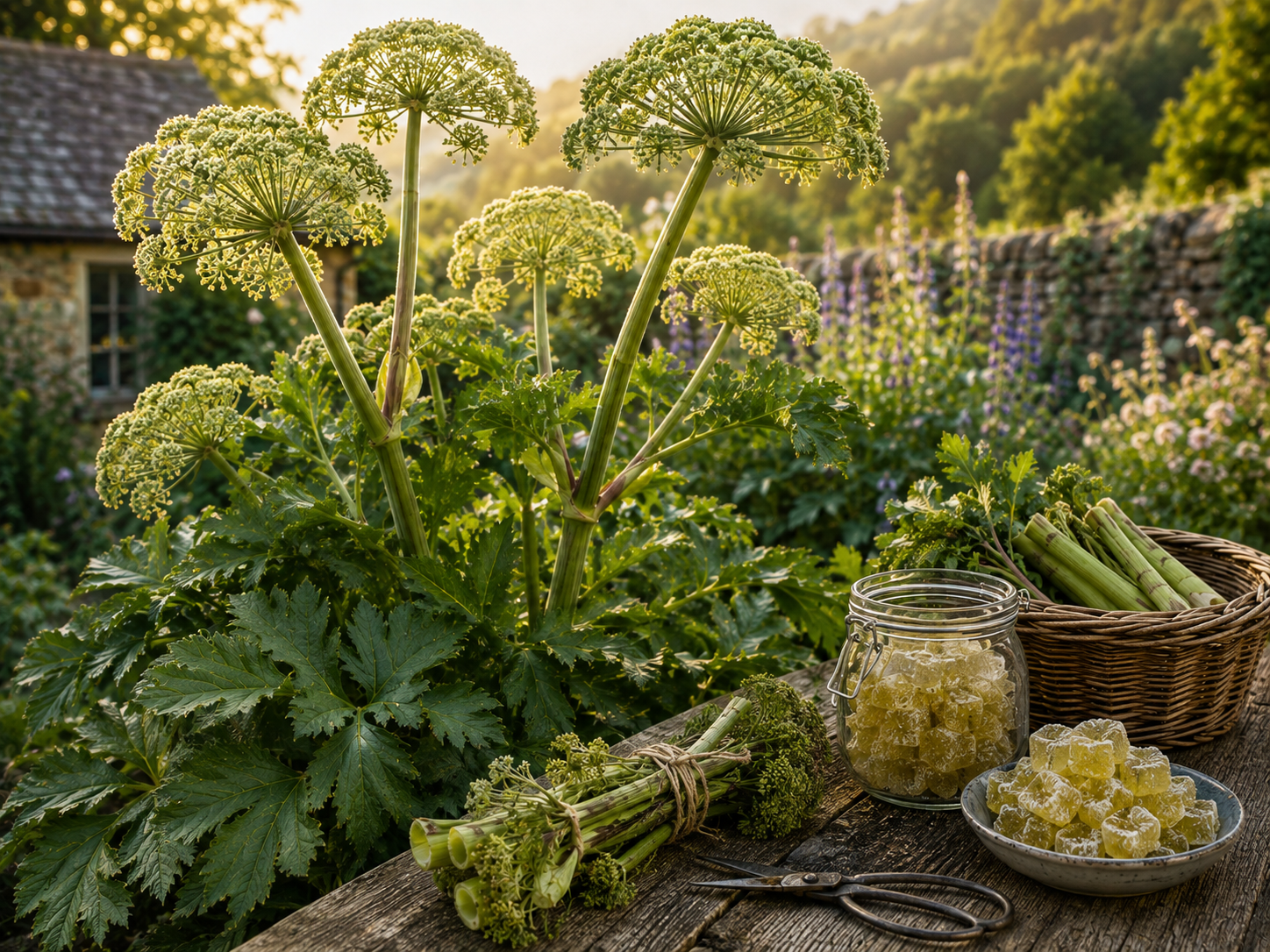
European angelica does not enter a garden quietly. It rises above neighboring herbs on thick hollow stems, opens broad green flower umbels toward the sky and carries an aromatic presence that feels almost architectural. For centuries, people have treated it accordingly: as food, flavoring, medicine, confectionery and, eventually, a plant wrapped in stories of angels and protection.
That combination makes Angelica archangelica one of the stranger bridges between the kitchen garden and the enchanted one. Its history includes candied stems on cakes, aromatic roots and seeds, damp northern landscapes, old apothecaries and a name grand enough to promise something celestial.
Meet European Angelica
European angelica (Angelica archangelica L.) belongs to the carrot and parsley family, Apiaceae. Kew Plants of the World Online accepts the species and gives its native range as Greenland and Europe east to western Siberia. It favors temperate climates and naturally occurs in damp places, including stream sides, riverbanks and other moist ground.
The plant can become impressively tall, with large divided leaves, thick hollow stems and rounded umbels of small greenish-white flowers. Kew describes it as a perennial. Gardeners also frequently encounter angelica described or managed as a biennial because its life cycle is strongly tied to flowering and seed production. The useful lesson is simpler than the terminology: give angelica room. This is not a windowsill herb pretending to be a shrub.
How to Grow European Angelica
Angelica is most at home where the soil stays reasonably moist without becoming stagnant. A position in full sun to moderate shade suits its natural preference for cool, damp habitats. In hot climates, protection from the fiercest afternoon sun and consistent moisture can matter more than squeezing out another hour of direct light.
Fresh seed is traditionally recommended because angelica seed can lose viability relatively quickly. Sow it when conditions are cool, or allow an established plant to self-sow if you want angelica to maintain a place in the garden. Mature plants need generous spacing for their foliage and towering flowering stems.
Keep the soil evenly moist, mulch where appropriate and avoid repeatedly disturbing the root system. Flowering plants can produce abundant seed. If maintaining the patch is the goal, allowing some seed to mature gives the next generation a chance to establish.
Harvesting Angelica
Different parts of angelica have entered different traditions. Young stems have been cooked and candied, while roots, leaves, fruits and seeds have also been used historically for flavoring or herbal preparations. Harvest timing therefore depends on what you intend to use.
There is an important practical caution before reaching for the garden knife: members of the genus contain furocoumarins. Plant sap or preparations can increase sensitivity to ultraviolet light and contribute to phototoxic skin reactions. Gloves, covered skin and sensible sun precautions are worthwhile when handling substantial quantities, particularly when cutting fresh stems on bright days.
The Herb That Became a Confection
For many people, angelica’s most charming surviving culinary tradition is candied angelica. The stems are cooked in syrup until sugar replaces much of their moisture, creating translucent green pieces once commonly used to decorate cakes, puddings and other sweets. Kew notes that candied stalks remain one of angelica’s best-known commercial uses and associates the craft especially with Niort in western France.
The flavor is difficult to reduce to one familiar herb: aromatic, green, slightly musky and sweet once candied. Angelica has also flavored liqueurs and other preparations. In that sense, the plant sits in the same old culinary territory as many herbs in this library—the border where food, preservation, fragrance and medicine were never completely separate categories.
Traditional Herbal Use and Modern Evidence
European angelica has a long history in European herbal practice. Historical sources and modern reviews describe the root in traditions concerned especially with digestion, appetite and aromatic preparations, alongside a much wider collection of older uses.
That history should not be confused with proof that angelica treats every condition once assigned to it. Modern research has examined the plant’s essential oils and other constituents, but many traditional claims do not have the kind of clinical evidence required to present them as established treatments. The old herbals are valuable records of how people understood the plant; they are not prescriptions.
Why Is It Called Angelica?
Few botanical names invite folklore as readily as Angelica archangelica. Kew records a tradition that the plant’s virtues were revealed to the medieval physician Mattheus Sylvaticus by an archangel. Centuries later, Nicholas Culpeper wrote of people calling angelica an “herb of the Holy Ghost” or connecting its name with its supposed angelic virtues.
Stories like these are better understood as part of angelica’s cultural biography than as a single provable origin story. What they show clearly is that Europeans came to imagine the plant as unusually protective and benevolent. Its imposing growth, powerful fragrance and medicinal reputation made fertile ground for sacred associations.
Folklore, Protection and the Magical Tradition
Angelica eventually became associated in European folk and later magical traditions with protection, blessing, purification and defense against harmful influences. Some traditions connected it with protection during epidemics; later herbal-magic systems expanded those associations into household protection, cleansing and spiritual guardianship.
As with other plants in this series, those correspondences are not one universal ancient doctrine. They accumulated across places, centuries and later occult traditions. The history is more interesting when we allow it to remain layered.
Angelica offers a beautiful symbolic idea anyway. Protection does not always have to look like hiding. Sometimes it looks like growing tall enough to change the shape of the garden—rooted in wet ground, fragrant when touched, carrying dozens of tiny flowers together above everything else.
Safety
European angelica deserves more caution than an ordinary culinary garnish. The European Medicines Agency has specifically assessed risks associated with furocoumarins in Angelica archangelica preparations because these compounds can be phototoxic. Kew likewise warns that angelica species can increase skin photosensitivity and cause dermatitis.
Avoid treating concentrated extracts or essential oils as equivalent to eating a traditionally prepared food. Anyone who is pregnant, breastfeeding, taking medication or considering medicinal doses should discuss the specific preparation with a qualified clinician or pharmacist. Correct identification also matters: Apiaceae contains several plants that can be confused by inexperienced foragers, including dangerous species. Do not consume a wild plant merely because it resembles angelica.
Why European Angelica Belongs in the Plant Library
Angelica is almost a miniature history of herbal culture by itself. A wet-ground plant became a vegetable, a flavoring, an apothecary ingredient, a cake decoration and a protective symbol. Each generation seems to have found another language for the same towering herb.
Maybe that is why the angelic name endured. The plant makes abundance visible. One root rises into a green tower; one stem divides; one umbel becomes hundreds of small points held together in the air.
Sometimes a plant earns its mythology simply by becoming difficult to ignore.
Sources & Further Reading
- Owen, W. (2016). Herbs: Guide to Plants, 500 Photographs, Recipes and Crafts. Popular UK, Pte. Ltd., pp. 126–127.
- Royal Botanic Gardens, Kew. Plants of the World Online: Angelica archangelica L.
- Royal Botanic Gardens, Kew. Angelica archangelica species profile and general information.
- European Medicines Agency, Committee on Herbal Medicinal Products. Reflection paper on the risks associated with furocoumarins contained in preparations of Angelica archangelica L.
- Kowalczyk, A. et al. (2021). “Back to the Roots—An Overview of the Chemical Composition and Bioactivity of Selected Root-Essential Oils.” Molecules.
This article is for botanical, historical and cultural education and is not medical advice.
Leave a Reply