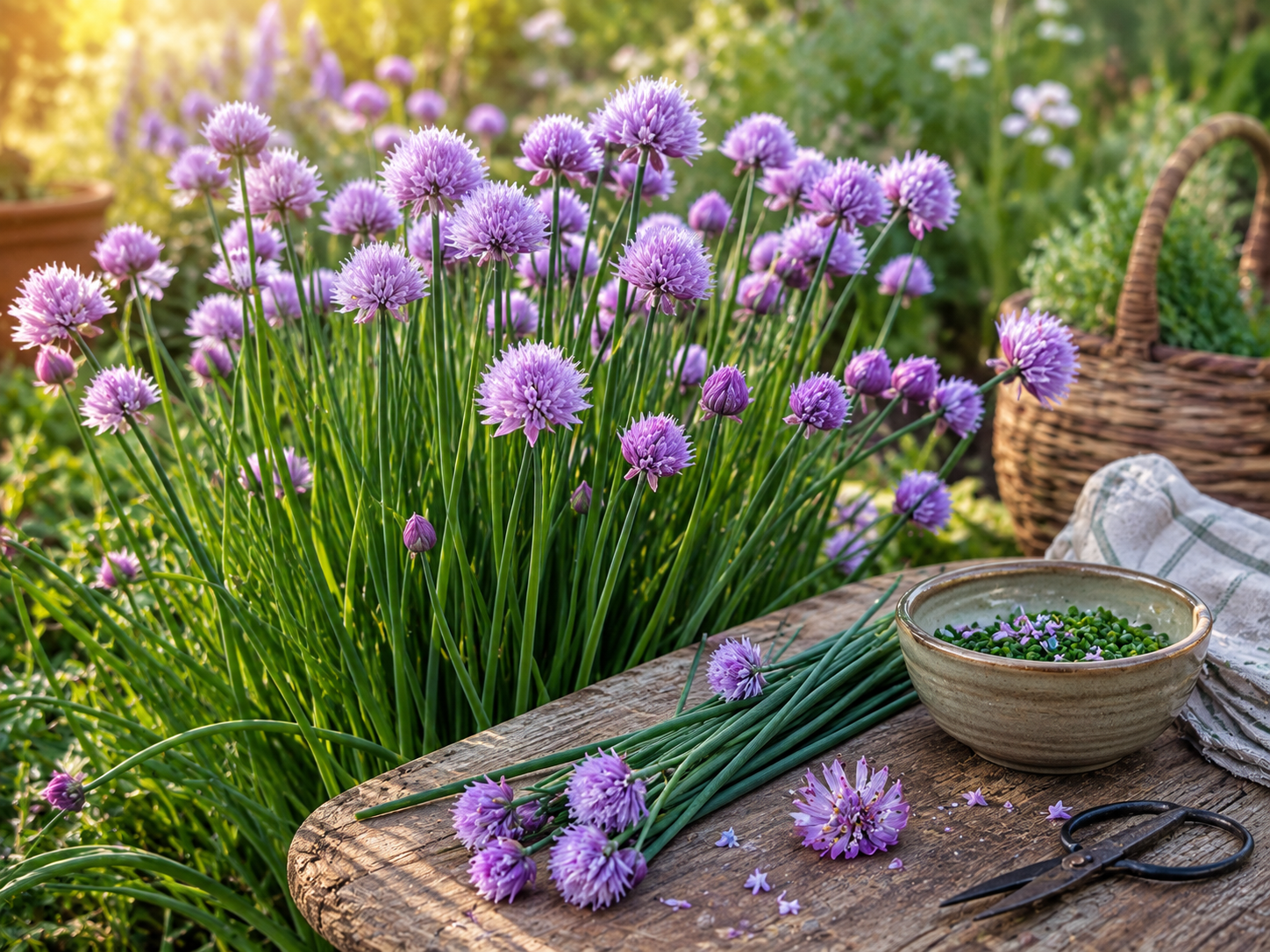
The chives plant is easy to underestimate. In the kitchen, its slender leaves often arrive finely snipped and scattered over potatoes, eggs or soup. In the garden, however, chives become something else entirely: dense fountains of hollow green leaves topped with lavender-purple globes, returning year after year and feeding early-season pollinators along the way.
Allium schoenoprasum is one of the gentler members of the onion family in flavor. Botanically and culturally, however, it carries many familiar Allium themes: food, fragrance, persistence and protection.
Meet Chives
Royal Botanic Gardens, Kew recognizes Allium schoenoprasum L. as an accepted species in the Amaryllidaceae family. Its native range stretches broadly across the temperate Northern Hemisphere. As a result, chives are unusual among familiar culinary herbs in having a naturally wide presence across parts of Europe, Asia and North America.
Chives are bulb-forming perennials. Their narrow green leaves are hollow and tubular, while the flowers gather into rounded heads that usually open in shades of pink, lilac and purple. Both the leaves and flowers have a place in the kitchen.
Chives vs. Garlic Chives
Ordinary chives and garlic chives are related, but they are not the same plant. Common chives are Allium schoenoprasum, while garlic chives are Allium tuberosum. Likewise, both belong to the broader onion family alongside familiar plants such as garlic.
Common chives have slender hollow leaves, rounded purple flower heads and a mild onion flavor. Garlic chives generally have flatter leaves, white starry flower clusters and a more distinctly garlicky flavor. Knowing the difference matters when growing them—and when a recipe expects one rather than the other.
How to Grow Chives
Chives are among the friendliest herbs for a beginning garden. They tolerate cold, return as perennials in many climates and gradually form larger clumps. The Royal Horticultural Society also recommends this hardy perennial for both garden beds and containers.
Give them sun to light shade and fertile, well-drained soil with regular moisture. You can start plants from seed, transplants or divisions from an established clump. As the clump becomes crowded, divide it every few years to give the plants more room and create new chive plants almost for free.
For harvest, cut leaves near the base rather than merely trimming the tips. The plant can then send up fresh growth, making chives a true cut-and-come-again kitchen herb.
Do Not Forget the Flowers
Chive blossoms are edible too. Separate individual florets from the flower head and scatter them over salads, eggs, soft cheeses and savory dishes for a delicate onion flavor and a flash of lavender color.
The flowers also reveal another reason to let at least part of a chive patch bloom: they attract visiting insects. For a few weeks, a plant grown for people becomes a small feeding station for the garden around it.
In the Kitchen
Chives are usually best fresh because long cooking can overwhelm their mild onion character. Instead, use snipped leaves as a finishing herb for potatoes, soups, eggs, sauces, vegetables, fish, soft cheeses and savory breads.
Their usefulness comes partly from restraint. Chives can bring an onion note to a dish without asking the whole dish to become about onion. They also pair naturally with other delicate herbs; for example, chives and chervil both appear in the French herb blend known as fines herbes.
Traditional Use and Modern Research
Like many members of Allium, chives have histories as both food and folk medicine. Modern chemical research has identified sulfur-containing compounds, flavonoids and other plant constituents in Allium schoenoprasum. In addition, laboratory studies have explored a variety of possible biological activities.
However, that is not the same as showing that eating chives—or taking a concentrated chive preparation—treats a particular disease. Reviews of the research continue to call for better investigation of active compounds, mechanisms, clinical relevance and safety. Therefore, the strongest everyday case for chives remains the oldest one: they are a flavorful edible plant that fits comfortably into a varied diet.
Folklore, Symbolism and the Magical Tradition
Modern magical-herbal sources often fold chives into the wider symbolic language of the onion family: protection, clearing, household well-being and the strengthening of boundaries. These correspondences vary between traditions. For that reason, they should not be mistaken for a single ancient belief shared everywhere chives grew.
Chives offer another symbolism simply through the way they live. Cut them and they return. Divide an old clump and one plant becomes several. Leave the flowers and the quiet green herb suddenly crowns itself in purple.
There is a kind of abundance that does not arrive dramatically. It gathers. It thickens at the roots. It survives winter, returns when the season changes and gives enough of itself to be cut without disappearing.
Safety
People widely eat chives as food. Even so, individual allergies or sensitivities are possible. Concentrated extracts or supplements also deserve separate consideration because they can expose the body to compounds in amounts very different from a garnish or handful of fresh leaves.
Correct identification matters. Chives belong to Allium, a genus containing many edible species, but never eat a plant solely because its leaves vaguely resemble chives. Chives and other Allium species can also harm dogs and cats, so manage kitchen scraps and garden plants accordingly around pets.
Why Chives Belong in the Plant Library
Not every useful plant needs to be rare, exotic or mysterious.
Chives are valuable precisely because they are ordinary enough to live beside the kitchen door. They connect the garden to dinner, flowers to food, pollinators to people and one growing season to the next.
Sometimes the plants worth knowing are already sitting quietly at the edge of the plate.
Sources & Further Reading
- Owen, W. (2016). Herbs: Guide to Plants, 500 Photographs, Recipes and Crafts, pp. 112–113.
- Royal Botanic Gardens, Kew. Plants of the World Online: Allium schoenoprasum L.
- Royal Horticultural Society. How to grow chives.
- Singh, V. et al. (2018). Allium schoenoprasum L.: a review of phytochemistry, pharmacology and future directions. Natural Product Research, 32(18), 2202–2216.
- Alam, A. et al. (2022). Allium vegetables: Traditional uses, phytoconstituents, and beneficial effects in inflammation and cancer.
This article is for botanical, historical and cultural education and is not medical advice.
Leave a Reply