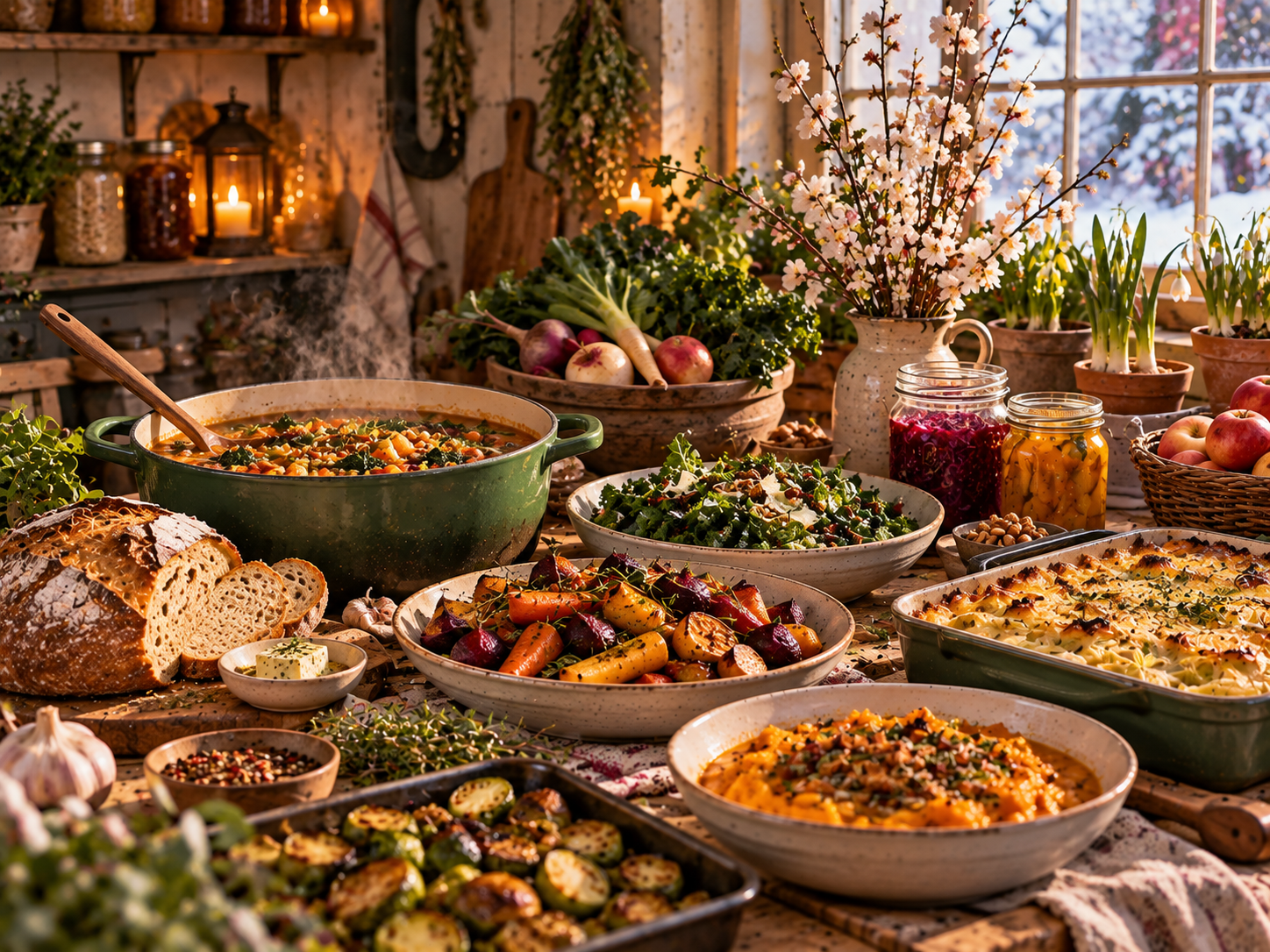
February is a hinge month in the seasonal kitchen. Winter is still very much present, but something has changed. The days are stretching. Seed packets are appearing on the table. In mild gardens, fresh growth may already be picking up, while colder gardens are beginning the season indoors long before the soil is ready.
The February kitchen reflects that shift. Stored roots, cabbage, winter squash and preserved foods still matter, but brighter flavors begin creeping in: citrus, tender greens, fresh herbs and, in the right climates, the earliest peas and quick cool-season crops.
What is seasonal in the February kitchen?
What February offers depends strongly on where you live. Mild-winter gardens may produce lettuce, spinach, kale, chard, radishes, broccoli, cauliflower, cabbage, herbs and other cool-season crops. Colder regions may still rely primarily on stored potatoes, carrots, beets, onions, garlic, winter squash and apples, alongside frozen, dried and safely preserved harvests. Citrus is also at its best in many growing regions during winter and brings a welcome brightness to the table.

1. Lemon, Leek & White Bean Pasta
Serves 4–6
Ingredients
- 12 oz pasta
- 2 tablespoons olive oil
- 2 leeks, cleaned and thinly sliced
- 3 garlic cloves, minced
- 1 15-oz can white beans, drained and rinsed
- 1 lemon, zest and juice
- 1/2 cup grated Parmesan
- 2 cups chopped spinach or tender kale
- Salt and black pepper
Instructions
- Cook pasta until al dente, reserving about 1 cup pasta water.
- Meanwhile, heat olive oil in a large skillet and cook leeks for 6–8 minutes until soft. Add garlic and cook 30 seconds.
- Add beans and greens and cook until the greens wilt.
- Add pasta, lemon zest, lemon juice and Parmesan. Toss with enough reserved pasta water to make a light sauce. Season to taste.
2. Honey-Roasted Carrots with Citrus & Herbs
Serves 4
Ingredients
- 1 1/2 lb carrots
- 1 1/2 tablespoons olive oil
- 1 tablespoon honey
- Zest and juice of 1/2 orange
- 1/2 teaspoon salt
- Black pepper
- 2 tablespoons chopped parsley, dill or cilantro
Instructions
- Heat oven to 425°F.
- Toss carrots with olive oil, honey, orange zest, salt and pepper.
- Roast 25–35 minutes until browned and tender.
- Finish with orange juice and fresh herbs just before serving.
3. Crispy Broccoli & Cheddar Potato Cakes
Makes about 10 cakes
Ingredients
- 3 cups cold mashed potatoes
- 1 1/2 cups finely chopped cooked broccoli
- 1 cup shredded cheddar
- 1 egg
- 1/3 cup breadcrumbs, plus more if needed
- 2 green onions, sliced
- Salt and black pepper
- Oil for pan-frying
Instructions
- Mix potatoes, broccoli, cheddar, egg, breadcrumbs and green onions. Season to taste.
- Form into patties. Add a little more breadcrumbs if the mixture is too soft.
- Heat a thin layer of oil in a skillet over medium heat.
- Cook cakes 3–4 minutes per side until crisp and golden.
Harvest rescue: This is exactly the kind of February recipe that turns yesterday’s mashed potatoes and a small amount of broccoli into an entirely new meal.
4. Beet, Lentil & Feta Bowls
Serves 4
Ingredients
- 3 medium cooked beets, cut into wedges
- 2 cups cooked green or brown lentils
- 3 cups spinach, arugula or mixed winter greens
- 1/2 cup crumbled feta
- 1/3 cup toasted sunflower seeds or walnuts
- 2 tablespoons olive oil
- 1 tablespoon lemon juice
- 1 teaspoon Dijon mustard
- 1 teaspoon honey
- Salt and black pepper
Instructions
- Divide greens and lentils among bowls and top with beets.
- Whisk olive oil, lemon juice, mustard, honey, salt and pepper.
- Drizzle dressing over the bowls and finish with feta and seeds or walnuts.
5. Garlic-Parmesan Cauliflower & Chickpea Sheet Pan
Serves 4
Ingredients
- 1 large head cauliflower, cut into florets
- 1 15-oz can chickpeas, drained, rinsed and dried
- 3 tablespoons olive oil
- 3 garlic cloves, minced
- 1/2 teaspoon smoked paprika
- 1/2 cup grated Parmesan
- Salt and black pepper
- Lemon wedges for serving
Instructions
- Heat oven to 425°F.
- Toss cauliflower and chickpeas with olive oil, garlic, paprika, salt and pepper.
- Roast 20 minutes, stir, then sprinkle with Parmesan.
- Roast another 10–15 minutes until deeply browned. Serve with lemon.
6. Pea, Herb & Ricotta Toasts
Serves 4
Ingredients
- 1 1/2 cups peas, fresh where locally available or frozen
- 1 cup ricotta
- 1 tablespoon lemon juice
- 1 teaspoon lemon zest
- 2 tablespoons chopped mint, parsley or dill
- 8 slices toasted rustic bread
- Olive oil
- Salt and black pepper
Instructions
- Cook peas briefly until tender, then lightly mash with lemon juice, herbs, salt and pepper.
- Spread ricotta over warm toast.
- Spoon peas over the ricotta and finish with lemon zest and a drizzle of olive oil.
Seasonal note: Fresh peas are not a February harvest everywhere. Frozen peas make this a useful bridge recipe while gardeners in suitable mild climates begin seeing the earliest local peas.
7. Orange, Apple & Oat Yogurt Muffins
Makes 12 muffins
Ingredients
- 1 1/2 cups all-purpose flour
- 1 cup rolled oats
- 2 teaspoons baking powder
- 1 teaspoon cinnamon
- 1/2 teaspoon salt
- 2 eggs
- 3/4 cup plain Greek yogurt
- 1/2 cup brown sugar
- 1/3 cup neutral oil
- Zest of 1 orange
- 1/3 cup orange juice
- 1 apple, finely diced
Instructions
- Heat oven to 375°F and line or grease a 12-cup muffin pan.
- Whisk flour, oats, baking powder, cinnamon and salt.
- In another bowl whisk eggs, yogurt, brown sugar, oil, orange zest and juice.
- Fold wet ingredients into dry just until combined, then fold in apple.
- Divide among muffin cups and bake 18–22 minutes.
8. Preserved Tomato & Cabbage Braise
Serves 6
Ingredients
- 2 tablespoons olive oil
- 1 onion, sliced
- 3 garlic cloves, minced
- 1 small cabbage, sliced
- 1 28-oz can crushed tomatoes or an equivalent amount of safely preserved tomatoes
- 1 teaspoon dried oregano
- 1/2 teaspoon smoked paprika
- 1 15-oz can white beans, drained and rinsed
- Salt and black pepper
- Fresh parsley, optional
Instructions
- Heat olive oil in a deep skillet or Dutch oven. Cook onion for 5 minutes and add garlic.
- Add cabbage and cook until it begins to soften.
- Add tomatoes, oregano and paprika. Cover and simmer 20–25 minutes.
- Stir in beans and cook until heated through. Season and finish with parsley if desired.
This is February’s reminder that preserving food changes what “seasonal” can mean. A tomato harvested in summer can still belong to a winter meal when it was safely canned or frozen for exactly this purpose.
9. Freezer-Friendly Spinach & Herb Pesto Cubes
Makes about 1 1/2 cups
Ingredients
- 3 cups packed spinach
- 1 cup mixed tender herbs such as parsley, cilantro or basil if available
- 1/2 cup toasted walnuts or sunflower seeds
- 1/2 cup grated Parmesan
- 1 garlic clove
- 1 tablespoon lemon juice
- 1/2 cup olive oil, approximately
- Salt and black pepper
Instructions
- Pulse spinach, herbs, nuts or seeds, Parmesan, garlic and lemon in a food processor.
- Drizzle in olive oil until the pesto reaches your preferred consistency. Season to taste.
- Spoon into small freezer-safe portions or silicone cube trays and freeze.
- Once solid, transfer cubes to a labeled freezer container. Use them in pasta, soups, eggs and sauces.
10. Early-Spring Greens & Potato Galette
Serves 6
Ingredients
- 1 prepared pie crust
- 1 tablespoon olive oil
- 1 small onion or leek, thinly sliced
- 2 medium potatoes, very thinly sliced
- 2 cups chopped spinach, kale or chard
- 1 cup shredded Gruyère, cheddar or mozzarella
- 1 teaspoon thyme
- Salt and black pepper
- 1 egg beaten with 1 teaspoon water, optional for brushing
Instructions
- Heat oven to 400°F. Cook onion or leek in olive oil until soft.
- Roll pie crust onto a parchment-lined baking sheet.
- Layer potatoes, cooked onion, greens and cheese in the center, leaving a 2-inch border. Season with thyme, salt and pepper.
- Fold the crust edges over the filling. Brush crust with egg wash if using.
- Bake 35–45 minutes until the potatoes are tender and crust is deeply golden.
February is when the garden starts answering back
January asks what you want to grow. February begins answering with action. That might mean sowing peas outdoors in a mild climate, starting onions beneath lights in a cold one, harvesting spinach from a protected bed or simply organizing seed packets while snow still covers the garden.
The kitchen changes with it. Heavy winter food does not disappear overnight, but lemon, herbs, tender greens and the promise of peas begin lifting everything toward spring.
Planting ahead for the March and April kitchen
February is one of those months when a planting calendar absolutely needs a climate disclaimer. Use your local frost dates, soil conditions and crop-specific instructions rather than planting by the calendar alone.
- In mild and warm-winter climates: continue succession sowing lettuce, spinach, arugula, radishes, carrots, beets, cilantro and other cool-season crops while conditions allow. Peas and potatoes may also be appropriate in many areas, and some gardeners begin preparing beds for the warm-season transition.
- In cold climates: much of the edible garden may still begin indoors. Depending on your last-frost date, February can be appropriate for slow-growing crops such as onions, leeks and some herbs, with other seedlings following later. Avoid starting warm-season vegetables simply because the seed packet is exciting—count backward from your transplant date.
- In the greenhouse or under protection: succession sowings of spinach, lettuce, arugula and radishes can keep small harvests coming. Ventilation becomes increasingly important as sunny days begin warming protected spaces.
- For the months ahead: check stored seed, order what is missing, prepare seed-starting mix and containers, and decide which spring crops deserve garden space before warm-season planting begins competing for it.
Some February sowings can reach the kitchen quickly—radishes and baby greens are good examples. Others are investments in April, May or even summer. That is part of the rhythm: the food on today’s plate and the seed going into today’s soil do not always belong to the same month.
What comes next?
March is where the seasonal kitchen begins to feel visibly alive again. Early greens, peas, radishes, herbs and cool-season vegetables start sharing the table with the last stored foods of winter—and the garden begins moving fast enough that keeping up becomes part of the fun.
Follow the whole edible year: Visit Seasonal Garden Recipes for month-by-month recipes, preserving ideas and what to plant next.
Leave a Reply