The Secret Life of Tarot · Part VIII
This article contains affiliate links. As an Amazon Associate, I earn from qualifying purchases.
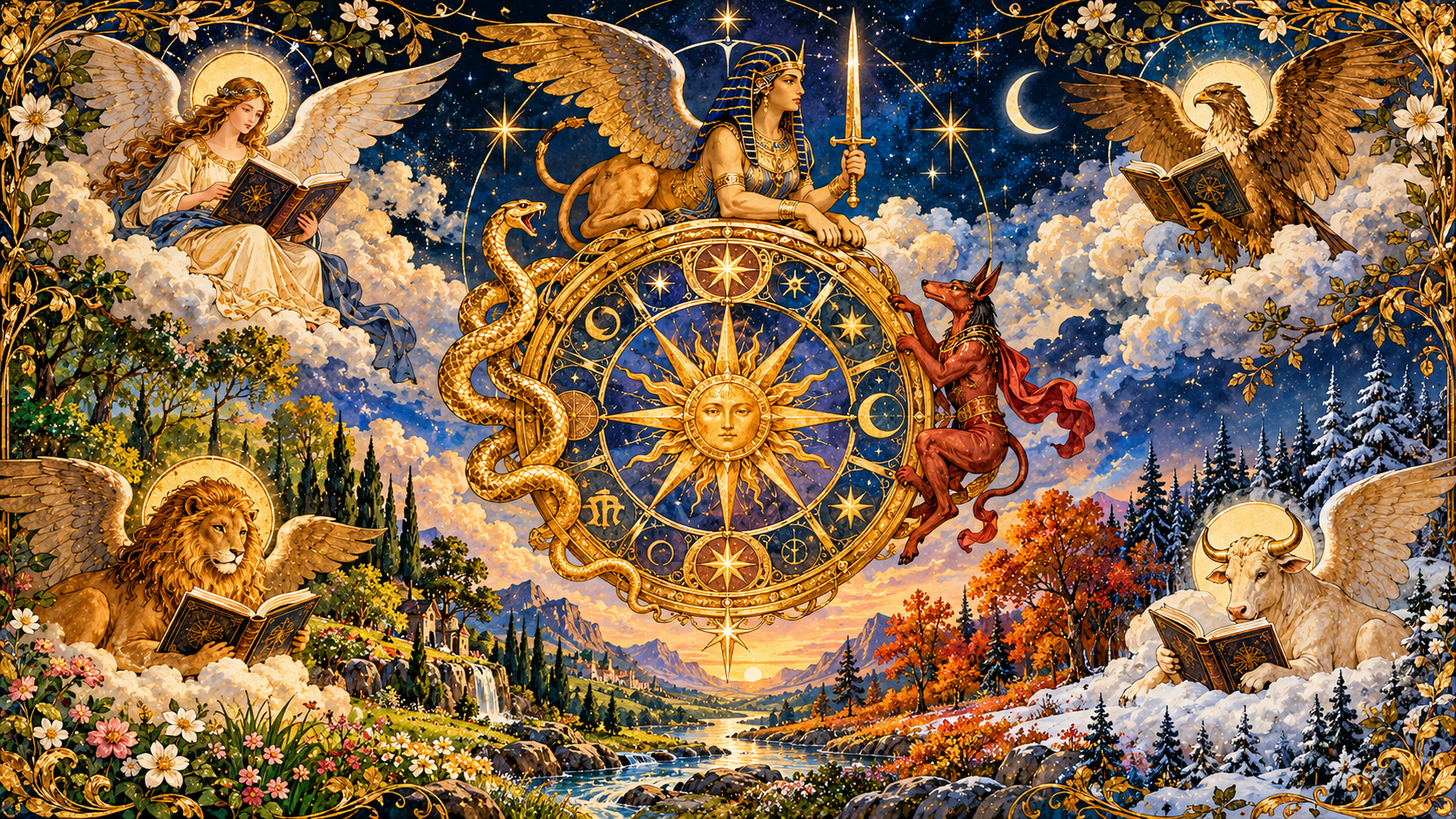
A golden wheel hangs in a pale sky, turning without a visible hand to guide it. A serpent slides down one side. A strange red creature rises on the other. Four winged figures watch from the corners, their books open.
And at the very top sits a blue sphinx, a sword balanced in its grasp.
Why place a creature famous for guarding mysteries on something that never stops moving? Why give it a sword when no enemy appears?
The Wheel of Fortune is often reduced to a simple message: luck changes. But Pamela Colman Smith drew a more extraordinary scene, in which everything seems to be in motion except the creature at its summit.
The sphinx’s secret may be less about predicting the next turn than learning how to meet it.

What Is the Sphinx Doing on the Wheel?
The Wheel of Fortune is Major Arcana X in the Rider–Waite–Smith tarot. Its great orange wheel occupies the center of the card, marked with letters and mysterious signs.
Above it crouches a blue figure with a humanlike face, a lion’s body, and a raised sword. Its posture is composed.
Arthur Edward Waite, who directed the deck’s symbolism, offered an unusually clear explanation. In The Pictorial Key to the Tarot, he wrote, “The Sphinx is the equilibrium therein.”
Equilibrium means a state of balance among forces. The sphinx is not necessarily the master of the wheel. It embodies a kind of steadiness within the turning.
Why a Sphinx Instead of an Ordinary Lion?
In ancient Egypt, the familiar sphinx combined a lion’s body with a human head, often representing a ruler. Such figures commonly stood as guardians at temples or along ceremonial approaches.
The lion suggested strength; the human face, intelligence and authority.
The Metropolitan Museum of Art documents their protective role.
Smith’s tarot sphinx belongs to a different artistic world. Waite openly acknowledged adapting the ideas of the nineteenth-century occultist Éliphas Lévi and combining Egyptian imagery with other traditions.
So the Wheel is not evidence that tarot originated in ancient Egypt. It is an intentionally assembled symbolic picture, borrowing from several histories to ask a larger question about existence.
Why Does the Sphinx Carry a Sword?
The blade points upward, but the sphinx is not striking anyone.
Waite did not give the sword a separate, definitive explanation in his description of this card. Modern readers often associate it with discernment, clear judgment, or the ability to distinguish one choice from another.
We may not know what comes next, but we can still examine what is happening and choose our response.
The sword need not cut through fate. It can cut through confusion.
What Are the Serpent and Red Creature Doing?
On the left, a yellow serpent descends beside the wheel. Waite explicitly identified it as Typhon in serpent form, drawing from his chosen occult imagery.
On the right, a reddish animal-headed figure climbs upward. It is commonly called Hermanubis in later tarot explanations, a name associated with a blending of Hermes and Anubis traditions. That identification belongs to the occult interpretation of the image; Waite’s own short description does not name the figure individually.
One creature falls while another rises. Their positions are temporary.
The image does not promise that every loss will soon bring a reward; change has no timetable.
What it shows beautifully is contrast: the downward and upward movements occur within the same image, beneath the watchful sphinx.
Who Are the Four Winged Creatures?
In each corner of the card is a winged being reading a book: a human or angel, an eagle, a lion, and a bull.
Waite identified them with the four living creatures in the biblical vision of Ezekiel, which includes human, lion, ox, and eagle imagery. Later esoteric interpretations also connect the four figures with the fixed signs of the zodiac.
Their bodies look lively, but they do not scramble after the turning wheel. Instead, they remain at the edges of the composition, absorbed in their books.
At the center, events whirl. Around the edges, four witnesses keep reading.
Perhaps they suggest a wider perspective: a story can contain more than the moment currently overwhelming us.
What Do TARO and ROTA Mean on the Wheel?
The wheel carries the Roman letters T, A, R, and O, alternating with Hebrew characters and other esoteric marks.
Waite described a relationship between Taro and Rota, the Latin word for wheel. He also connected the Hebrew letters with the Divine Name and the idea of providence.
These inscriptions reveal the card’s deliberately layered design, not a simple code that yields a guaranteed prediction.
Letters rearrange, positions change, and the circle remains.
What Can the Seasons Teach Us About the Wheel?
Nature offers a helpful parallel, although the card was not drawn as a science lesson.
Earth completes an orbit around the Sun each year. Its tilted axis changes the distribution of sunlight, producing seasons that return without making every year identical.
Consider a tree in a temperate climate. During a growing season, it produces new wood. A cross-section may reveal annual rings: traces of growth shaped by temperature, rainfall, and other conditions.
Winter comes again. Spring comes again. Yet the tree does not become the sapling it was last spring. Another layer has formed.
That is a more generous way to imagine the Wheel of Fortune. A cycle may return us to a familiar situation without returning us to an unchanged self.
The season repeats; the tree remembers.
Can You Find Stability Without Stopping Change?
Waite made one especially revealing observation: some depictions placed the sphinx on a fixed pedestal above the wheel, but he objected because that removed the essential relationship between stability and movement.
Its balance matters precisely because the wheel turns.
We cannot escape every uncertainty, and balance does not mean feeling calm every moment.
It may mean remembering which choices remain ours even as circumstances shift.
The Wheel turns. The sphinx stays present.
Upright and Reversed Meanings
Upright, the Wheel of Fortune is commonly associated with changing circumstances, cycles, opportunity, and turning points. The sphinx invites reflection on how to remain discerning when events gather momentum.
Reversed, readers may consider resistance to change, repeating patterns, or a feeling of being at the mercy of events. Rather than promising bad luck, the card can become a prompt to examine what is controllable and what is not.
Neither orientation can guarantee a particular future.
A Wheel of Fortune Reflection
Place the card where you can study its figures: the sphinx, the two creatures beside the wheel, and the four watchers at the corners.
Then ask:
- What is changing around me that I cannot stop?
- What judgment or value helps me stay steady while it changes?
- When have I returned to a familiar challenge as a different person?
If you want to study the original imagery closely, explore the Rider–Waite Tarot Deck on Amazon. To follow repeated symbols across readings, explore a Tarot Journal on Amazon.
Frequently Asked Questions
Is the sphinx on the Wheel of Fortune Egyptian?
It draws on sphinx imagery associated with Egypt, but Waite combined it with nineteenth-century occult interpretations and biblical symbols. Its presence does not establish an ancient Egyptian origin for tarot.
What does the sphinx’s sword mean?
A common interpretation is discernment or clear judgment. Waite explained the sphinx as equilibrium but did not assign the sword an independent, fixed meaning in his card description.
What do the four creatures around the wheel represent?
Waite connected them to the living creatures of Ezekiel. Some readers also associate them with the zodiac’s four fixed signs.
The Stillness That Travels With Us
At first glance, the Wheel of Fortune seems to be a card about everything we cannot keep: a position, an opportunity, a familiar season.
Look at the sphinx again.
It does not demand that the wheel stop. It occupies the highest point in a picture where motion and balance exist together.
The tree grows another ring. We revisit familiar places carrying new experiences.
Perhaps the deepest mystery is not where the wheel will take us, but what remains steady enough to travel with us.
Continue Exploring
Follow another mysterious creature into The Moon’s crayfish or explore renewal and movement in The Star’s two streams of water.
Sources and Further Reading
- Arthur Edward Waite, The Pictorial Key to the Tarot: X, Wheel of Fortune.
- Pamela Colman Smith, Wheel of Fortune, original 1909 card.
- The Metropolitan Museum of Art, Think Sphinx.
- Ezekiel 1:10, four living creatures.
- NASA, Facts About Earth.
- U.S. Forest Service, Tree Rings and the Local Environment.

Leave a Reply