Tea tree oil has one of those aromas that makes an immediate statement.
It is sharp, green, medicinal, earthy and unmistakably clean-smelling—not floral, not sweet, and not particularly interested in being subtle.
That powerful character has helped tea tree essential oil become a familiar ingredient in everything from shampoos and facial products to household products. It has also accumulated an enormous collection of claims along the way.
Some are supported by preliminary research. Some are traditional uses. Others have raced far ahead of the evidence.
So tea tree gives us a perfect opportunity to do what this Essential Oils Library is meant to do: enjoy the plant, understand the oil, look honestly at the science and use concentrated botanical products with respect.

What Is Tea Tree Essential Oil?
Tea tree essential oil—also called tea tree oil or melaleuca oil—is most commonly associated with Melaleuca alternifolia, a member of the myrtle family, Myrtaceae.
Kew’s Medicinal Plant Names Services recognizes Melaleuca alternifolia as an accepted botanical name and documents its long-standing association with tea tree oil.
Despite the name, this is not the tea plant used to make black, green or white tea. Those drinks come from Camellia sinensis.
Tea tree is an entirely different plant.
From Australian Leaves to Essential Oil
Tea tree essential oil is produced by steam distilling the leaves and terminal branches of the plant.
The National Center for Complementary and Integrative Health (NCCIH) notes that Melaleuca alternifolia is native to New South Wales and Queensland in Australia and that tea tree oil has a history of traditional use among Aboriginal Australians.
Modern tea tree oil is a concentrated aromatic product, however, and should not be treated as though it were simply a handful of leaves.

What Does Tea Tree Essential Oil Smell Like?
Tea tree essential oil is often described as:
- sharp
- green
- medicinal
- earthy
- camphoraceous
- fresh
- slightly woody
It isn’t an oil everyone chooses simply because it smells beautiful.
Tea tree’s appeal is often more functional: it smells crisp, botanical and intensely clean.
Ways to Use Tea Tree Essential Oil
1. Use Tea Tree in a Diffuser Blend
Tea tree can be diffused for its distinctive fresh herbal aroma, although many people find it more pleasant blended than used alone.
Try pairing its sharper character with lemon, lavender or another complementary aromatic oil.
Follow the directions for your diffuser and remember that stronger isn’t automatically better.
2. Choose Properly Formulated Tea Tree Skin Products
Tea tree appears in cleansers, gels, creams and other topical products.
For beginners, a professionally formulated product can be much easier to use appropriately than improvising with a bottle of 100-percent essential oil.
If you’re making your own topical aromatic product, proper dilution matters.
3. Look for Tea Tree in Scalp and Hair Products
Tea tree is also common in shampoos and scalp-care products.
Again, a finished shampoo containing tea tree oil is not equivalent to pouring concentrated essential oil directly onto your scalp.
Read the ingredient list and follow the directions for the actual product you’re using.
4. Blend Tea Tree Rather Than Trying to Hide It
Tea tree has too much personality to disappear completely into most blends.
Instead of trying to disguise it, use another oil to change its character.
Tea Tree Essential Oil Blends
Tea Tree + Lemon
Bright citrus gives tea tree’s medicinal green character some sparkle.
Tea Tree + Lavender
Lavender softens tea tree and makes the blend feel rounder and less severe.
Tea Tree + Peppermint
This is intensely fresh territory. Both oils are assertive, so restraint matters.
Tea Tree + Rosemary
Herbal, green and unapologetically botanical.
Tea Tree + Cedarwood
Cedarwood brings a dry, woody base beneath tea tree’s sharper top notes.
What Does Research Actually Say About Tea Tree Oil?
Tea tree is often described online as though it were a cure-all antimicrobial medicine.
The actual human evidence is much narrower.
NCCIH’s evidence review of tea tree oil reports that a small amount of research suggests topical tea tree oil may be helpful for acne and athlete’s foot, but more evidence is needed. Evidence for fungal nail infections and several other promoted uses is insufficient or uncertain.
That distinction matters.
Laboratory evidence that an essential oil can affect microorganisms under particular experimental conditions does not automatically prove that a bottle of oil will safely or effectively treat an infection in a person.
Tea tree oil can be scientifically interesting without becoming a replacement for appropriate medical care.
Tea Tree Oil for Acne
Acne is one of tea tree oil’s most commonly promoted topical uses.
There is some limited human research suggesting that products containing tea tree oil may help with acne, but that evidence isn’t strong enough to justify treating concentrated tea tree essential oil as a universal acne treatment.
Skin is complicated.
More concentrated does not necessarily mean more effective, and irritation can make an already unhappy face considerably unhappier.
If tea tree interests you for skincare, consider a product formulated for facial use rather than experimenting with undiluted essential oil.
Tea Tree Oil for Athlete’s Foot and Nail Fungus
Tea tree is also commonly promoted for fungal skin and nail problems.
NCCIH reports limited evidence that topical tea tree oil may help athlete’s foot, although it may not work as well as standard treatments. Research on fungal nail infections is too limited to support firm conclusions.
If a skin or nail problem persists, worsens, becomes painful or looks infected, proper diagnosis matters more than continuing to experiment with home remedies.
Tea Tree Oil Should Not Be Swallowed
This deserves its own section because “natural” is sometimes mistaken for “safe to ingest.”
Tea tree essential oil should not be swallowed.
NCCIH reports that oral ingestion can cause serious symptoms including confusion, unsteadiness, inability to walk and coma.
Poison Control’s tea tree oil guidance likewise identifies tea tree oil as poisonous when swallowed and advises against using it in or around the mouth.
So this is not an oil to add to water, tea or homemade wellness drinks.
If someone swallows tea tree oil, contact Poison Control or an appropriate medical professional for individualized guidance rather than trying an internet remedy.
Tea Tree Essential Oil and Skin Irritation
Tea tree can cause redness, irritation or allergic skin reactions in some people.
There is another interesting wrinkle: storage matters.
NCCIH notes that skin reactions may be more likely when tea tree oil is old or has been exposed to heat, light or air. Oxidation can change the chemistry of an essential oil over time.
That makes the forgotten bottle sitting half-open on a sunny bathroom shelf a particularly poor candidate for skincare.

The Tea Tree Behind the Bottle
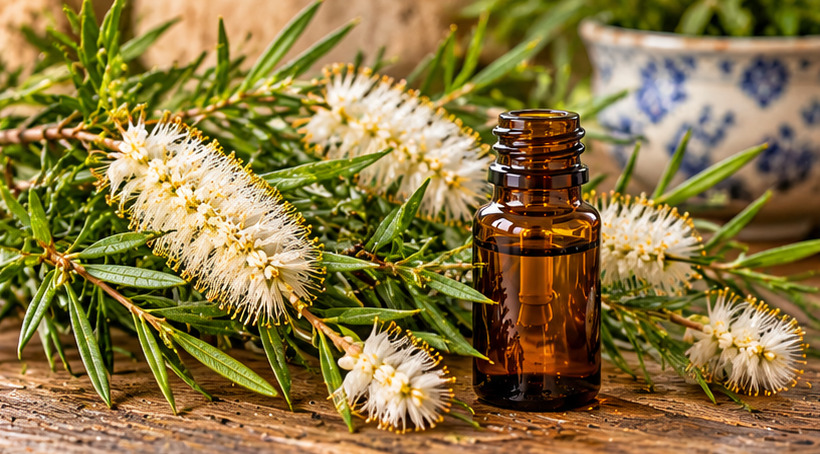
Melaleuca alternifolia is an Australian plant with narrow leaves and pale, brush-like flowers.
It belongs to Myrtaceae, a botanical family that also contains eucalyptus, another aromatic Australian plant we’ll eventually meet in this library.
The story of tea tree oil is inseparable from Australia.
NCCIH records traditional use of tea tree leaves by Aboriginal Australians, while modern commercial cultivation transformed the plant into an internationally familiar essential oil.
As always, it’s worth remembering that a modern bottle on a store shelf represents only one chapter in a much longer relationship between people and plants.
Can You Grow Tea Tree at Home?
Depending on climate and growing conditions, Melaleuca alternifolia can be cultivated as a shrub or small tree.
But unlike mint or rosemary, tea tree isn’t likely to be an everyday garden herb for most readers.
And that’s useful perspective too.
An essential-oil collection can bring us into contact with plants from ecosystems very different from our own. Not every bottle needs to become a backyard crop.
Protect pets from concentrated oil: Tea tree essential oil can be toxic to dogs and cats when swallowed or applied to their skin. Do not apply concentrated essential oils directly to animals. Keep oils secure and consult your veterinarian before diffusing essential oils around pets; avoid diffusion around birds. The ASPCA explains precautions for essential oils and pets.
Tea Tree Essential Oil Safety
Keep the central rules simple:
- Do not swallow tea tree essential oil.
- Keep it away from the eyes and mouth.
- Use topical products according to their directions.
- Remember that concentrated essential oil and a finished cosmetic product are not interchangeable.
- Stop using a product if significant irritation or an allergic reaction develops.
- Store essential oils securely away from children.
Tea tree’s long history of use does not make concentrated essential oil harmless.
Respect the concentration.
For diffusion, follow your device instructions, use short sessions with ventilation, and avoid exposing infants or people with respiratory sensitivities to concentrated scents. Stop if irritation or breathing discomfort develops.
How to Store Tea Tree Essential Oil
Keep tea tree oil tightly closed, away from direct sunlight and excessive heat, clearly labeled and securely out of children’s reach.
Good storage isn’t merely about making an essential-oil collection look tidy. Tea tree oil can oxidize as it ages, and exposure to air, heat and light may increase the likelihood of skin reactions.
What Should You Look for When Buying Tea Tree Essential Oil?
Look beyond the words TEA TREE on the front label.
For the classic Australian tea tree essential oil discussed in this article, look for the botanical name Melaleuca alternifolia.
A transparent seller may also provide:
- plant part
- extraction method
- country of origin
- batch or lot information
- chemical testing
- storage guidance
If you’re buying tea tree for your face, scalp or another topical purpose, also ask whether you actually need pure essential oil at all.
A well-formulated finished product may make far more sense.
Helpful Supplies for Tea Tree Aromatherapy and Skincare

This section contains paid affiliate links. As an Amazon Associate I earn from qualifying purchases, at no additional cost to you.
Jojoba Carrier Oil
Useful as a carrier for properly diluted adult aromatic blends; it is not a substitute for a finished acne product. Explore jojoba carrier oil.
Essential-Oil Storage Box
Store concentrated oils upright and tightly closed, away from sunlight, heat, children and pets. Explore the essential-oil storage box.
Amber Glass Roller Bottles
Use amber roller bottles for adult aromatic blends that are properly diluted, clearly labeled and suitable for topical use. Never use concentrated tea tree oil directly on skin or pets. Explore amber glass roller bottles.
Ultrasonic Essential-Oil Diffuser
For those choosing to enjoy the aroma, follow manufacturer directions, ventilate the room and avoid use around pets or anyone sensitive to concentrated fragrance. Explore the ultrasonic diffuser.
Tea Tree Beyond the Bottle
Tea tree isn’t the prettiest scent in the cabinet.
It doesn’t need to be.
Its story takes us somewhere else—into Australian botany, traditional plant knowledge, modern skincare, microbiology, toxicology and the strange journey by which one aromatic tree became a bathroom-cabinet staple around the world.
And it teaches one of the most important lessons in this entire library:
A plant can be useful without being miraculous.
An essential oil can be natural without being harmless.
And understanding the difference doesn’t make plants less magical.
It makes them more interesting.


Leave a Reply