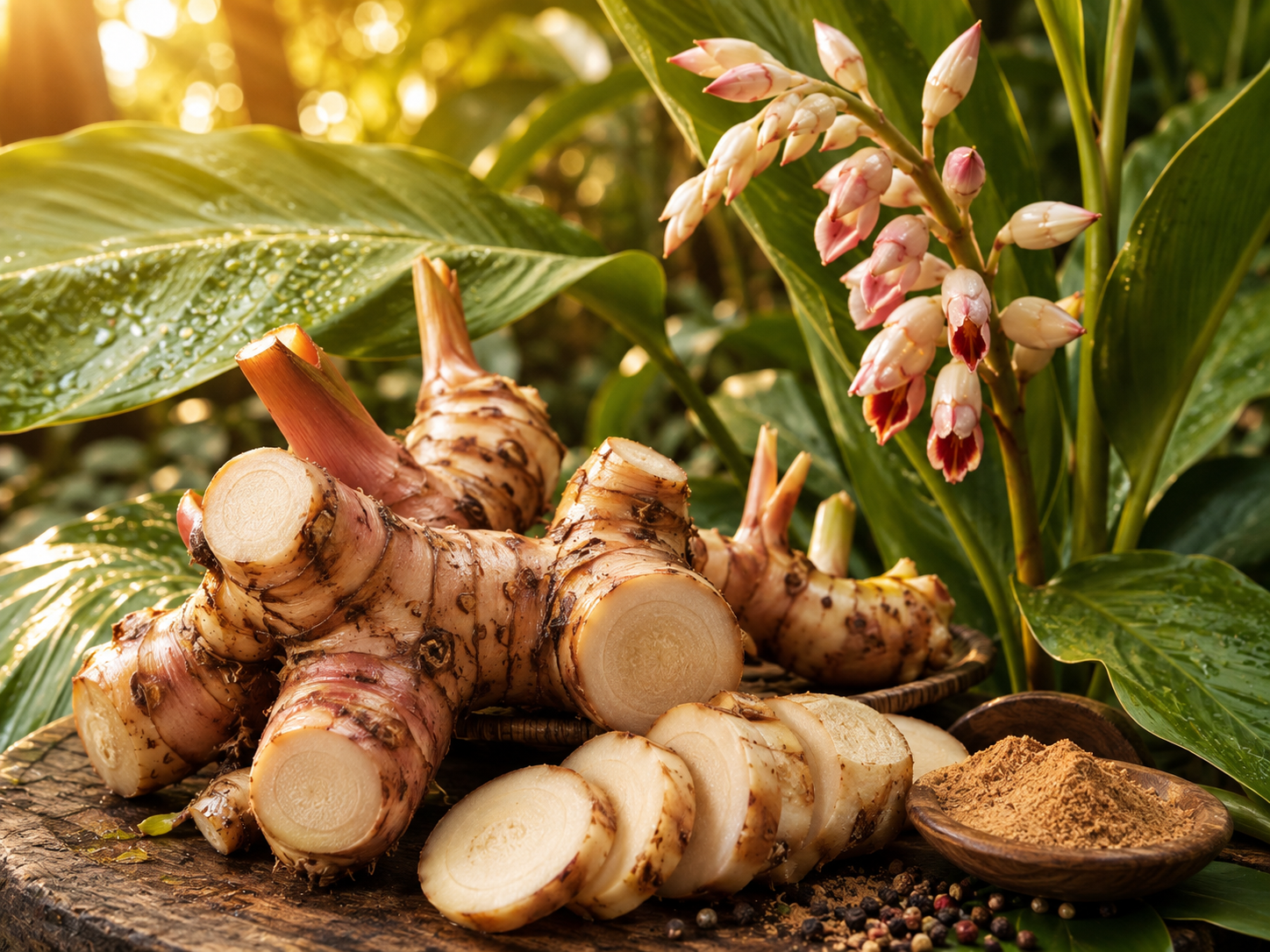
Galangal looks familiar until you cut it.
At first glance, the pale knobbled rhizome can resemble ginger. Then the knife meets firmer flesh and the fragrance rises: peppery, citrusy, pine-like and distinctly its own. Alpinia galanga, often called greater galangal, belongs to the ginger family, but treating it as simply another ginger misses most of its story.
Meet Galangal
Galangal is a rhizomatous tropical plant in the Zingiberaceae family—the same family that includes ginger, turmeric and cardamom. Royal Botanic Gardens, Kew recognizes Alpinia galanga (L.) Willd. as an accepted species native from southern China through parts of mainland Southeast Asia and western and central Malesia. It grows primarily in wet tropical environments.
The plant grows from underground rhizomes and produces tall leafy shoots above them. Although its flowers and foliage are beautiful, it is the aromatic rhizome that made galangal an enduring kitchen spice and trade good.
Galangal vs. Ginger
Galangal and ginger are relatives, not interchangeable names for the same plant. Ginger is Zingiber officinale; greater galangal is Alpinia galanga. Fresh galangal is typically firmer and more difficult to slice, and its flavor tends toward sharp pepper, citrus, resin and pine rather than ginger’s warmer familiar heat.
There is another complication: “galangal” has historically been applied to several aromatic plants. Greater galangal, lesser galangal and other species have sometimes traveled under overlapping common names. That makes the scientific name especially useful when researching culinary or medicinal traditions.
How to Grow Galangal
Galangal’s native ecology tells us what it wants: warmth, moisture and a long growing season. In genuinely tropical and subtropical climates it can grow as a substantial perennial. Gardeners in colder regions can treat it more like a tender tropical, growing rhizomes in containers or protecting them from frost.
Plant viable rhizome sections in rich, well-drained soil and keep them consistently moist without leaving them waterlogged. Warm soil and bright light encourage growth. Because the harvest develops underground, patience matters; the leafy plant above the soil is feeding the rhizome that will eventually return to the kitchen.
A Rhizome Built for the Kitchen
Galangal is deeply embedded in the cuisines of Southeast Asia, particularly in Thailand, Indonesia and Malaysia. It appears in soups, curries, spice pastes and aromatic preparations where its fragrance works alongside ingredients such as lemongrass, makrut lime leaves, chiles and coconut.
Its role is not merely “make this spicy.” Galangal contributes aroma as much as heat. A 2025 review of its culinary history describes its pungency as accompanied by fruity and aromatic notes, helping explain why replacing it with ginger changes more than intensity—it changes the shape of the dish.
Galangal Traveled Farther Than You Might Expect
Galangal belongs strongly to Asian culinary traditions, but its historical trail reaches surprisingly far west. Medieval European sources mention spices called galangal or galingale, and later medieval trade brought an aromatic spice under those names through Arab and Venetian networks.
There is an important historical caution here. Old words do not always map neatly onto modern botanical species. Researchers note that some early European references may describe greater galangal, lesser galangal or even a different plant called galingale. The uncertainty is part of the story: spices traveled across languages as well as borders.
Traditional Herbal Use and Modern Research
Galangal has also been used in traditional medical systems across parts of Asia. Ethnobotanical and pharmacological reviews document a broad history of preparations involving the rhizome, including traditions associated with digestive, respiratory and inflammatory complaints.
Modern laboratory research has investigated numerous compounds and biological activities in Alpinia galanga. That research is interesting, but laboratory activity is not the same thing as proof that a homemade preparation treats a disease in people. Here, as throughout this plant library, traditional use, laboratory research and demonstrated clinical treatment should remain three different categories.
Folklore and the Magical Tradition
In contemporary Western folk-magic and magical-herbal traditions, galangal is often associated with protection, luck, prosperity, success, justice and the breaking of unwanted influences. These correspondences are not universal botanical facts, nor should they be projected backward onto every culture that has cooked or worked medicinally with the plant.
Still, galangal makes an evocative symbol. Its useful part grows underground, storing energy out of sight before sending green shoots upward. Its flavor does not whisper. It cuts through.
Some plants soothe. Galangal clarifies by contrast. Its symbolic lesson might be that warmth is not always softness: sometimes warmth is momentum, appetite, courage and the clean heat required to move again.
Safety
Using galangal as a normal culinary spice is different from taking concentrated extracts, supplements or essential-oil preparations. Research into medicinal applications remains an evolving field, and traditional use should not be treated as proof of safety or effectiveness for a particular condition.
If you are pregnant or breastfeeding, giving concentrated preparations to children, taking prescription medicines or considering galangal in medicinal amounts for an existing condition, ask a clinician or pharmacist for individualized guidance. Correct identification also matters because several plants may be sold or discussed under similar galangal names.
Why Galangal Belongs in the Plant Library
Galangal widens the map of this collection. It reminds us that an herb garden is not the whole history of useful plants, and that the kitchen itself can be an archive.
A slice of rhizome dropped into a pot can carry climate, trade, language, family cooking and generations of observation with it. Sometimes history is written in books. Sometimes it is bruised with a pestle until the whole room becomes fragrant.
Sources & Further Reading
- Owen, W. (2016). Herbs: Guide to Plants, 500 Photographs, Recipes and Crafts, pp. 120–121.
- Royal Botanic Gardens, Kew. Plants of the World Online: Alpinia galanga (L.) Willd.
- Spence, C. (2025). Galangal, ‘the spice of Life’: History, flavour chemistry, and culinary uses. International Journal of Gastronomy and Food Science, 42, 101372.
- Ramanunny, A. K. et al. (2022). Journey of Alpinia galanga from kitchen spice to nutraceutical to folk medicine to nanomedicine. Journal of Ethnopharmacology, 291, 115144.
This article is for botanical, historical and cultural education and is not medical advice.
Leave a Reply