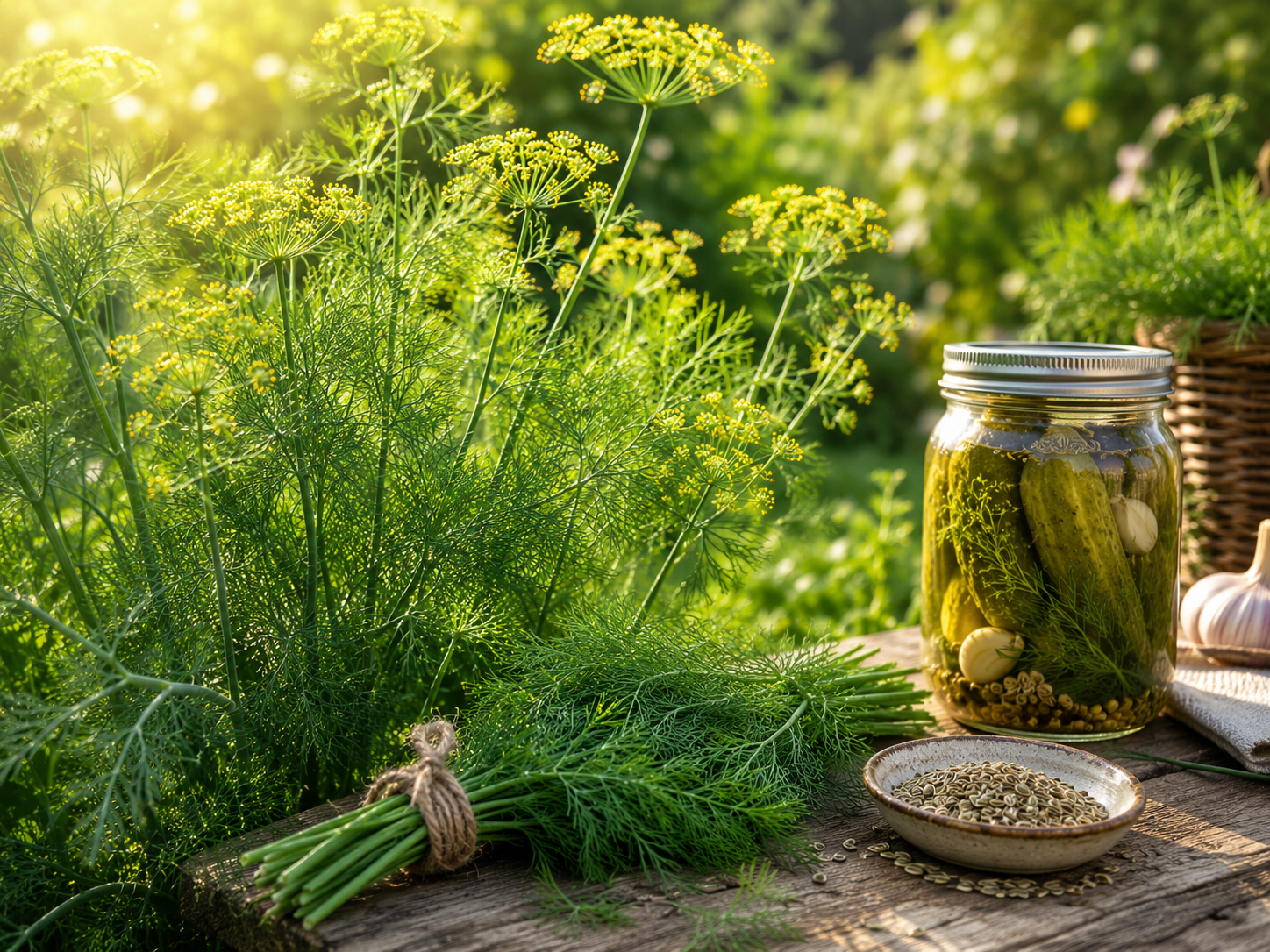
The dill plant can hide in plain sight. We know it from pickle jars, potato salads and the unmistakable green fronds scattered over food. Yet in the garden, dill becomes something larger and airier: feathery blue-green foliage, tall stems and broad yellow flower umbels that seem to hover above the bed.
Known botanically as Anethum graveolens, the dill plant has traveled through kitchens, gardens and traditional herbal practices for centuries. Its leaves and aromatic fruits—usually called dill seeds in the kitchen—have both earned places in food, preservation and folklore.
Meet Dill
Dill (Anethum graveolens L.) belongs to the carrot family, Apiaceae. Royal Botanic Gardens, Kew recognizes it as an accepted annual species. Its native range extends from North Africa to Chad and from Iran to the Arabian Peninsula, while cultivation has carried it far beyond that range.
The plant is easy to recognize once you know its shape: upright, slender stems; finely divided, threadlike blue-green leaves; and broad, airy umbels of tiny yellow flowers. Those flowers eventually produce flattened aromatic fruits commonly called seeds.
How to Grow Dill
The dill plant completes its life cycle in a single growing season. Sow it directly where you want it to grow in a sunny, sheltered position with reasonably well-drained soil. The Royal Horticultural Society recommends outdoor sowing from mid-spring and succession sowing into summer for a longer supply of fresh leaves.
Keep young plants watered while they establish. Once mature, dill can become surprisingly tall and delicate-looking, with flower heads held above its feathery foliage. Because the plant eventually shifts its energy toward flowering and seed production, several small sowings can provide tender foliage over a longer period.
Harvest fresh foliage as needed. For seed, allow the flower heads to mature until the fruits turn light brown, then collect them before too many scatter. Dill can also reseed itself when conditions suit it, so a few plants left to mature may return in a later season.
Dill Weed vs. Dill Seed
The phrase dill weed usually refers to the fresh or dried leafy parts of the plant. Their flavor is bright, green and immediately recognizable. Dill seed, meanwhile, refers to the mature fruits used as a spice. The two come from the same plant, but they behave differently in the kitchen.
The leaves are especially familiar with potatoes, cucumbers, fish, eggs, soups, sauces and dairy-based dishes. The seeds stand up well to pickling brines, breads, vinegars and other preparations where a stronger aromatic note is useful. Like chervil, dill belongs to the Apiaceae family, although their flavors and culinary roles are distinct.
The Herb Behind the Pickle Jar
For many people, dill and pickles are almost inseparable. The relationship makes practical sense: dill foliage, flower heads and mature fruits can all contribute aroma to preserved cucumbers. However, the herb’s culinary life reaches far beyond the pickle jar.
Its long culinary history stretches through regions of Europe, Asia, North Africa and the Middle East, where people have valued both leaves and fruits for their fragrance. Modern kitchens inherited only part of a much broader food tradition.
Traditional Use and Modern Evidence
Dill also has a long history in traditional medicine. Historical sources describe the fruits or seeds in preparations associated with digestion and abdominal discomfort, among other uses. Kew’s compiled botanical records likewise document historical food and medicinal uses of Anethum graveolens. These records tell us how people used the plant; they do not prove that dill treats a medical condition.
Modern laboratory research has examined dill extracts and essential oils for various biological activities. However, laboratory findings do not automatically translate into proven clinical benefits in people. Culinary use also differs substantially from taking concentrated extracts, supplements or essential oils.
Folklore, Protection and the Magical Tradition
Dill has carried symbolic meanings far beyond the kitchen. Historical herb lore records associations with sleep and protection, while later European traditions connected dill with protection against unwanted influences. As with many plants, the surviving stories come from different places and periods rather than one universal tradition.
Modern magical correspondence lists often extend those ideas into protection, luck, prosperity, love or household blessing. These correspondences are best understood as evolving traditions, not as a single unchanged system inherited from antiquity.
Dill’s magic, if we want to call it that, is almost domestic. It does not need a remote mountain or a rare bloom. Instead, it grows beside the vegetables, scatters seed, perfumes the kitchen and slips into the pantry for winter.
Safety
People widely use dill as a culinary herb and spice. Even so, individual allergy or sensitivity is possible, especially for people who react to other members of the carrot family. Concentrated essential oils and medicinal preparations deserve separate caution because they can provide exposures very different from ordinary food use.
If you are pregnant, breastfeeding, taking medication or managing a health condition, ask a qualified health professional before using concentrated dill preparations. Correct identification also matters whenever gathering any plant from the Apiaceae family.
Why Dill Belongs in the Plant Library
The dill plant is familiar enough to overlook and old enough to reward attention. Its leaves lead to the kitchen. Yellow flowers lead to seed, and those aromatic seeds lead onward to preservation, traditional medicine and stories about protection.
Sometimes the distance between a garden herb and an enchanted plant is only the distance between using something and learning its story.
Sources & Further Reading
- Owen, W. Herbs: Guide to Plants, 500 Photographs, Recipes and Crafts. Popular UK Pte. Ltd., 2016, p. 125.
- Royal Botanic Gardens, Kew. Plants of the World Online: Anethum graveolens L.
- Royal Horticultural Society. How to grow dill.
This article is for botanical, historical and cultural education and is not medical advice.
Leave a Reply